
Place That Means Something
Spatial computing as a truthful projection of state, consent, work, and social commitment
Abstract
Glyphd’s Architectural Home proposes that digital place becomes a real interaction paradigm only when a room or object projects or declares meaningful state. The map is not a second database, furniture is not disguised navigation, ambient activity is forbidden unless a real event occurred, presence is declared rather than surveilled, and social weight derives from bounded commitments and receipts rather than follower count or engagement extraction. The architecture coexists with faster radial, Workfield, Corolla, list, and keyboard projections over the same Project Core.
Abstract
Spatial software often takes one of two forms: an immersive world whose objects are decorative, or a conventional application with a three-dimensional menu. Neither automatically creates a meaningful place.
The Glyphd Architectural Home proposes a stricter contract: a room, threshold, or object belongs in the spatial layer only when it projects real persistent state or declares a state change with visible consequences, authority, provenance, privacy, and an efficient non-spatial equivalent.
The map is never a second database. Nothing moves unless something actually happened. Presence is declared, not silently inferred. A Door is a consent boundary, a Porch is graduated availability, an Interior is private by default, and a District is discovery around real affinity and contribution rather than a feed stretched onto a map.
The research question is not whether a house is attractive. It is whether place-declared state improves ownership, memory, comprehension, completed work, and voluntary social sharing over faster projections using the same underlying system.
1. The house ruling
A spatial object passes when selecting it:
- declares or changes meaningful state;
- changes authorized behavior, context, visibility, or policy;
- projects real persistent state;
- exposes consequence and authority;
- resolves to inspectable events and receipts;
- has an accessible non-spatial equivalent.
It fails when clicking furniture merely opens unchanged software. That object is a menu wearing a costume.
2. Projection discipline
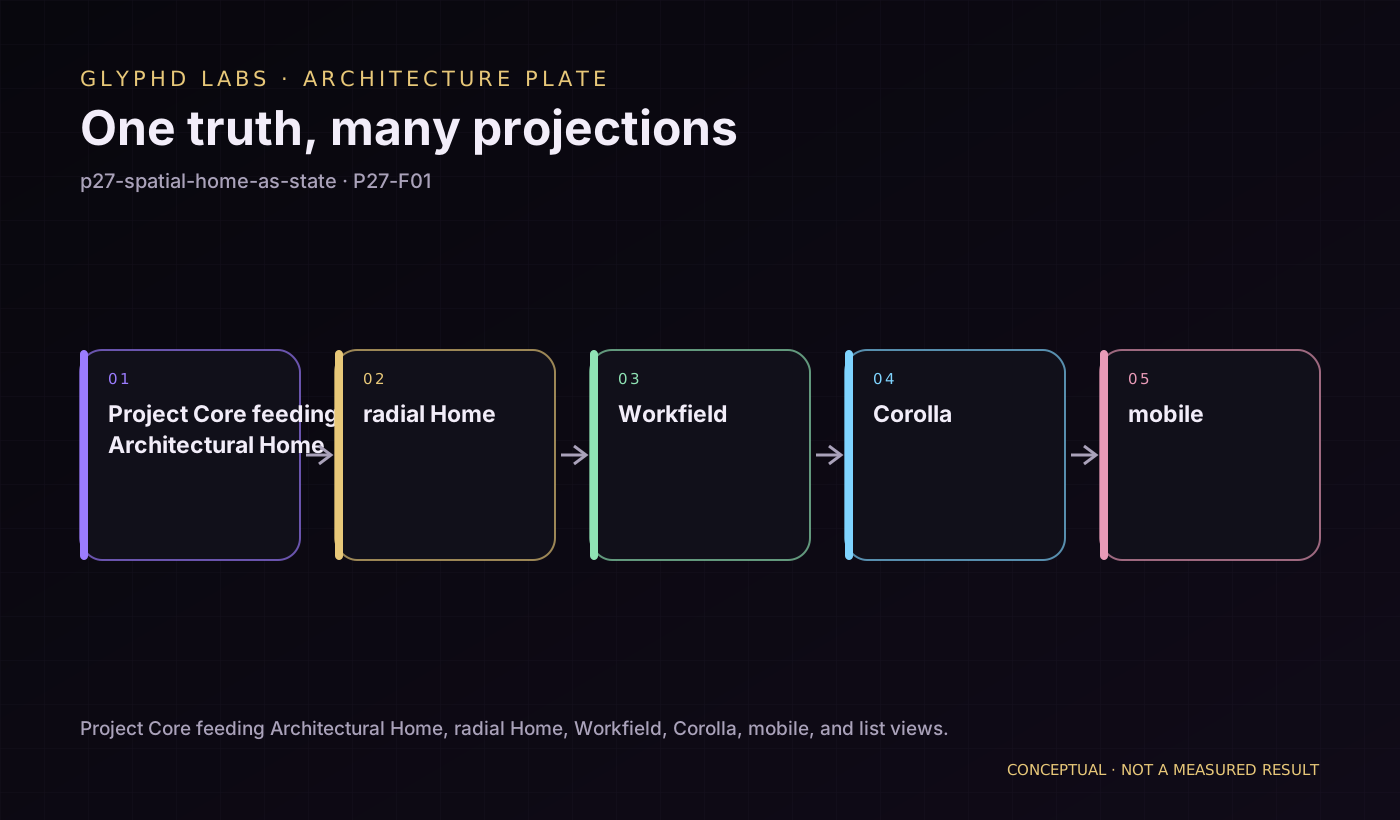
Architectural Home, radial Home, Universal Workfield, Context Corolla, list views, mobile views, and accessibility views are projections over one Project Core.
canonical Project state
→ projection contract
→ architectural Home
→ radial Home
→ Workfield
→ Corolla
→ list / keyboard view
No projection can create a private state that the others cannot reconcile. A change in one view resolves to the same event and object identity.
3. Aliveness invariant
Nothing in the Home moves unless something actually happened.
Ambient changes must resolve to:
- a Return;
- a Receipt;
- a Station heartbeat;
- a visitor request;
- a declared presence change;
- a real deadline or status transition.
Unknown progress remains unknown. The system does not animate fake workers, fabricate visitors, or create decorative motion to imply intelligence.
This invariant is crucial because spatial animation can make false activity more persuasive than a text status label.
4. Provenance-decoration
Residents display what they made, contributed, learned, received, or deliberately preserved. Visible objects carry Artifact identity and lineage.
Decoration therefore becomes a legible body of work rather than a cosmetic status market.
A wall object may represent:
- an accepted design;
- a completed course;
- a contribution received;
- a project milestone;
- a shared world artifact;
- a source the resident chose to preserve.
Purchasing decoration cannot purchase truth, moral worth, or governance weight.
5. Declared presence
Declared presence, not surveilled presence.
A resident may declare “at the Desk,” “on the Porch,” “in Focus,” or “away.” An explicitly enabled bounded sensor may assist, but the source, scope, duration, audience, and revocation remain visible.
Presence can influence:
- active Project restoration;
- notification posture;
- availability;
- StandingPolicy selection;
- permitted automatic preparation.
It cannot silently grant permission to send, spend, publish, expose private data, or operate physical devices.
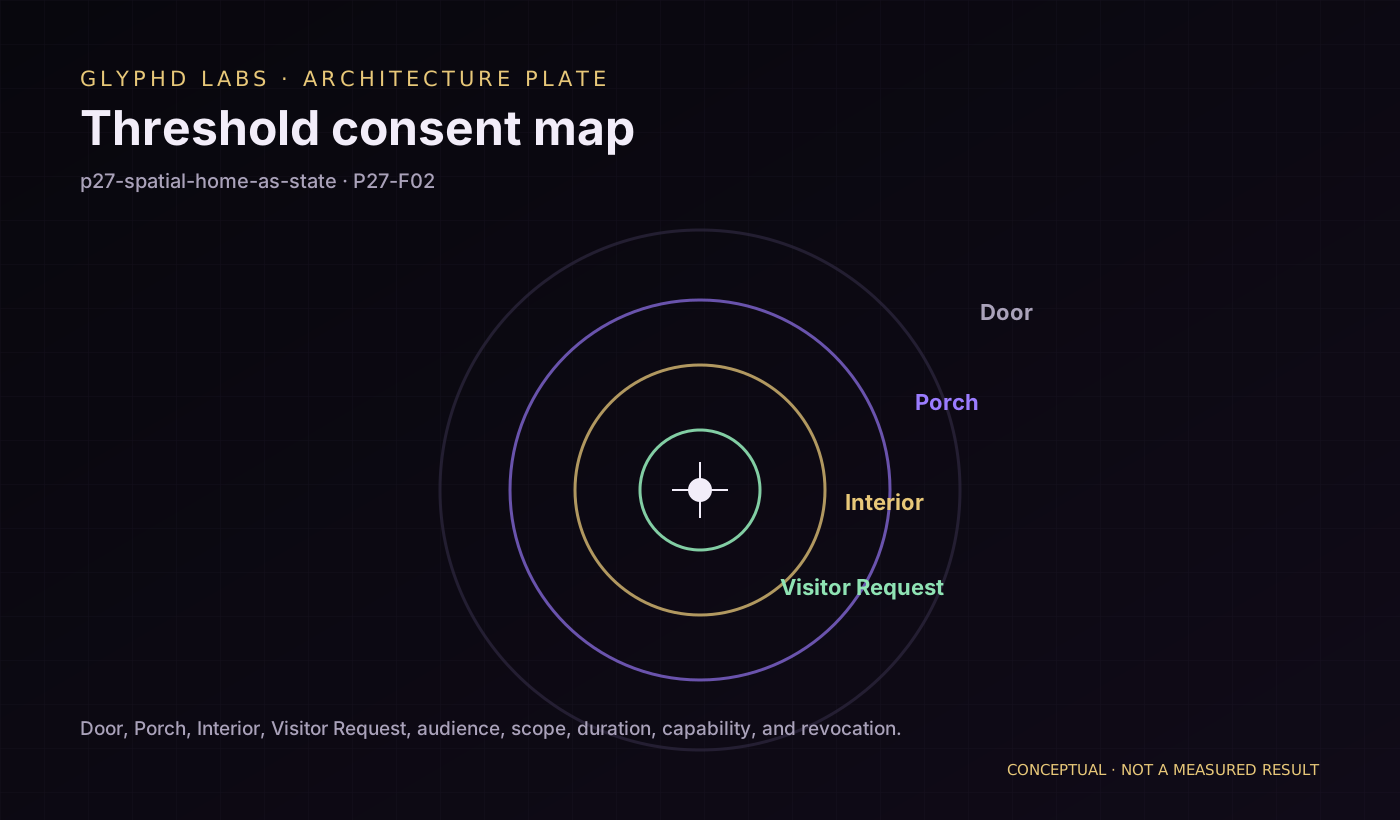
6. Threshold consent
Spatial thresholds are consent surfaces.
Door
The public WELCOME boundary: identity, selected work, proof, availability, and invitation controls.
Porch
Graduated availability. A resident can specify audience, duration, interaction type, and whether Zeke may answer or queue.
Interior
Private by default. Invitation scope includes room, object, capability, time, visibility, recording, and revocation.
Visitor Request
An outside request waits for preview, decline, defer, block, route, or bounded admission. A message never becomes permission.
The interface uses the spatial metaphor to make capability change legible, not to conceal it.
7. State without conversation
A major hypothesis is that users should be able to communicate operational state without composing a chat turn.
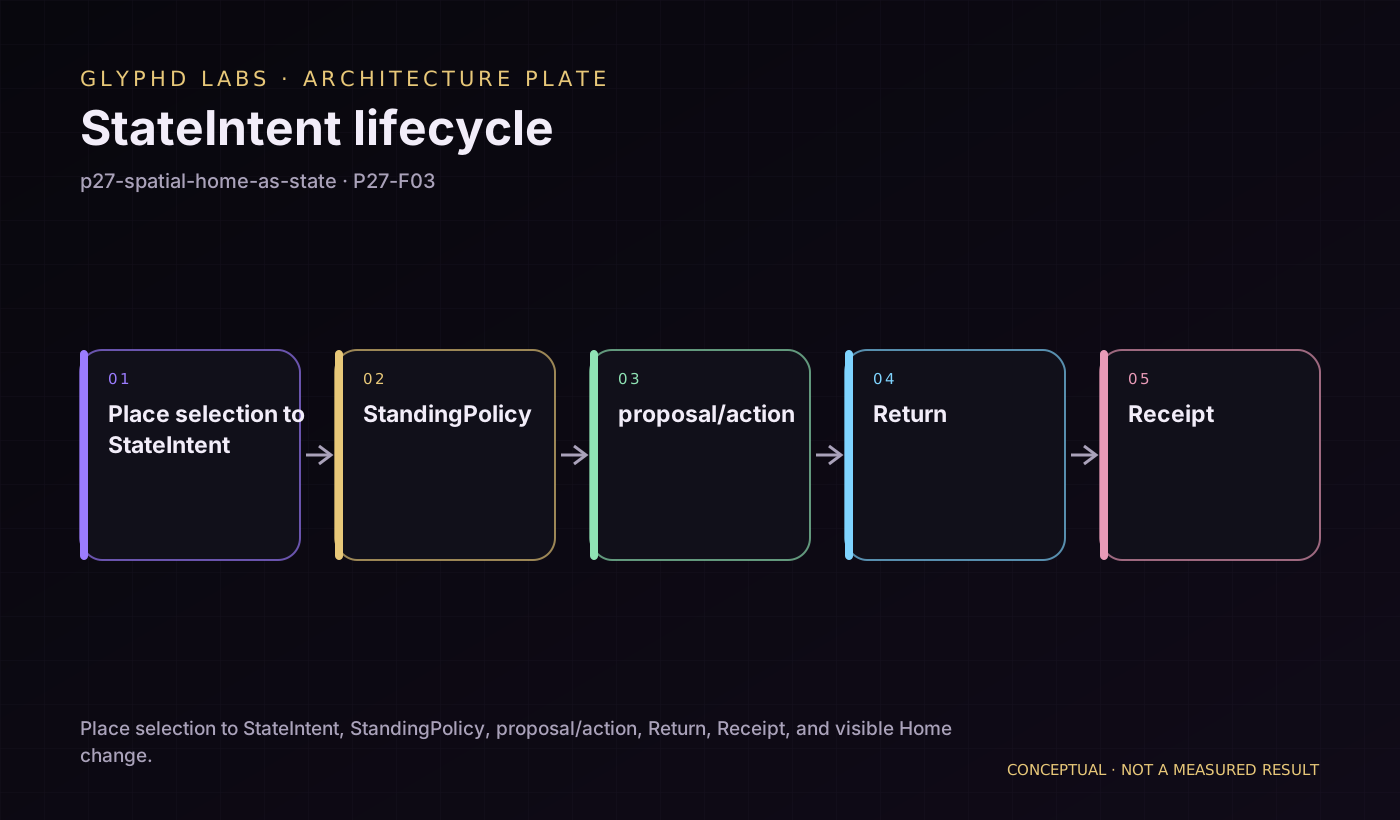
resident selects place or object
→ StateIntent recorded
→ context and visibility update
→ StandingPolicy evaluated
→ permitted preparation occurs
→ proposals, Returns, and Receipts update projections
Examples:
- Desk restores an active Project and its evidence surface;
- Porch sets bounded availability;
- Bed activates a reviewed Sleep Policy;
- Workshop exposes authorized Stations;
- Door changes selected public projections.
Place selection is not blanket authority.
8. Social atom: bounded shared acts
Glyphd's social unit is not a post, follower, or raw reaction. It is a bounded shared act:
invitation
→ commitment
→ Work Order or contribution
→ Return
→ verification
→ Receipt
Social weight derives from useful participation and kept commitments. Receipts prove that an exact event occurred; they do not prove moral worth.
A District is organized around real work, place, learning, or affinity. It launches with a real founding cohort rather than fake city-scale population.
9. Anti-engagement doctrine
The Home does not manufacture reasons to return.
Prohibited patterns include:
- streak coercion;
- artificial decay;
- fake visitors;
- false scarcity;
- simulated worker activity;
- notifications detached from real commitments;
- follower-count dominance;
- purchased cosmetic governance.
The aim is durable relationship and work, not extraction of attention.
10. Alternate projections are protected
Spatial place is not always the fastest interface. Radial, Workfield, Corolla, list, and keyboard projections remain first-class.
The architecture succeeds by assigning jobs:
- Home: ownership, place, presence, social threshold, orientation;
- Workfield: deep work and context composition;
- Corolla: compact state navigation;
- list/keyboard: speed and accessibility;
- mobile: bounded one-handed state and action.
The experiment need not select one permanent winner.
11. Architectural Home experiment
Compare:
- A: Architectural Home;
- B: Radial Home / Workfield / Corolla.
Both use identical projects, Zeke behavior, tasks, permissions, latency, capabilities, and evidence.
Primary measures:
- meaningful
StateIntentuse; - sessions producing a real Return;
- Doors voluntarily shared.
Secondary measures:
- time to resume a project;
- time to approve a Work Order;
- navigation errors;
- permission comprehension;
- false assumptions about Zeke's access;
- voluntary projection switching;
- recall of object and evidence locations;
- sense of ownership;
- willingness to return without a manufactured prompt.
12. Failure conditions
Reduce or remove the spatial layer if:
- furniture is mostly navigation;
- ambient motion lacks events;
- users misunderstand permissions;
- spatial navigation materially harms focused work;
- the Home adds atmosphere but no meaningful behavior;
- list and radial views are treated as second-class;
- public surfaces leak private Project state.
A valid outcome may retain Door and social orientation while making faster views primary for work.
13. Current evidence state
The corpus contains founder-reviewed system locks, interface prototypes, vocabulary, a 36-frame design atlas, a detailed A/B experiment, and preserved alternate projections. The integrated V1 runtime remains SPECIFIED; the house-specific behavioral claims are hypotheses awaiting the matched experiment.
14. Security and accessibility
Every spatial action requires a keyboard/list equivalent. Focus order, screen-reader naming, reduced motion, narrow layouts, contrast, and explicit state text are mandatory.
Privacy boundaries cannot rely on architectural intuition alone. A closed-looking door is not access control; grants and server/runtime checks are.
15. Conclusion
Spatial computing becomes meaningful when place carries state, consequence, memory, consent, and proof. The Architectural Home is not a claim that every application should become a house. It is a proposal that human ownership and social threshold can be made spatial without abandoning exact state, fast interfaces, or visible authority.
Its success will be measured not by visual novelty but by whether people remember, resume, declare, complete, understand, and share more meaningfully.
Source register
GLYPHD-V1-MASTER-SPEC-LOCKS-AND-EXPERIMENT-PLAN-v0.1.mdGLYPHD-V1-BUILD-THREAD-HANDOFF-2026-07-18.mdZEKE-V1-CANON-RECOVERY-AND-GAP-AUDIT-v0.1.md- Architectural Home and Registry/Project Desk visual source plates
Revision history
- 0.1.0 — 2026-07-27: Initial public-safe institute edition.
P27-C01SPECIFIEDThe Glyphd Home corpus specifies a spatial projection contract based on aliveness, provenance-decoration, declared presence, threshold consent, and protected alternate projections.
- Integrated production runtime is not yet evidenced here.
P27-C02HYPOTHESISPlace-declared state improves ownership, work yield, comprehension, and voluntary sharing over matched non-architectural projections.
- Controlled user evidence has not been published.
These provenance records identify sources used by the publication. An internal path is not a public download unless a link is explicitly provided.
P27-S01P27-S02P27-S03Public-disclosure boundary
This paper publishes the system thesis, architecture, contracts, evidence state, limitations, and falsification criteria. It does not publish confidential claim charts, private patent strategy, secrets, credentials, customer material, unreleased datasets, or implementation details designated as trade secret. The public paper does not grant a license to implement the Covered Technology. See LICENSE.md and NOTICE.md in the Glyphd Labs repository.