
A Spatial Grammar for Work State
Context Corolla, Identify, and Release & Route across Now, Next, Delegated, Review, Blocked, and Dormant
Task systems usually represent work as lists, boards, or calendars. These surfaces are useful but often force the user to translate their lived relationship to work into generic statuses. Context Corolla proposes a compact spatial grammar organized around six practical states—Now, Next, Delegated, Review, Blocked, and Dormant—with Identify at the center and Release & Route as the voice/action transition.
The Corolla is not a project database. It is a protected projection over one Project Core. Rotating or selecting a spoke changes focus and prepares a bounded context; it does not silently authorize work. Items retain provenance, evidence, authority, and project identity. The same state can be rendered as radial, list, keyboard, mobile, or accessible views.
The research question is whether stable spatial state reduces resumption cost, mode confusion, and context reconstruction while preserving the speed of lists. The system remains a specified interaction architecture with runnable prototype lineage; broad productivity uplift is not claimed.
Abstract
Task systems usually represent work as lists, boards, or calendars. These surfaces are useful but often force the user to translate their lived relationship to work into generic statuses. Context Corolla proposes a compact spatial grammar organized around six practical states—Now, Next, Delegated, Review, Blocked, and Dormant—with Identify at the center and Release & Route as the voice/action transition.
The Corolla is not a project database. It is a protected projection over one Project Core. Rotating or selecting a spoke changes focus and prepares a bounded context; it does not silently authorize work. Items retain provenance, evidence, authority, and project identity. The same state can be rendered as radial, list, keyboard, mobile, or accessible views.
The research question is whether stable spatial state reduces resumption cost, mode confusion, and context reconstruction while preserving the speed of lists. The system remains a specified interaction architecture with runnable prototype lineage; broad productivity uplift is not claimed.
1. Why six states
The six spokes answer different operational questions.
Now
What deserves active attention?
Next
What becomes valid after the current frontier changes?
Delegated
What is in another person's, agent's, or tool's bounded Work Order?
Review
What returned and requires inspection, verification, or acceptance?
Blocked
What cannot proceed, why, and what event would unblock it?
Dormant
What remains intentionally preserved but inactive?
The center asks:
What is this?
Identification precedes routing. A raw thought should not be forced into a project state before its object and scope are understood.
2. The Corolla as projection
Each visible item resolves to a Project Core object:
item_ref
project_id
state
object_type
source
authority
evidence
updated_at
next_transition
Moving an item on the Corolla creates a proposed state transition. The canonical event system validates it.
Deleting the radial layout loses zero project truth.
3. Spatial meaning
The geometry communicates state without requiring every label to be reread.
- center = unresolved identity;
- upper/forward = current attention;
- adjacent forward = next valid action;
- outward/shared = delegated;
- returning = review;
- constrained = blocked;
- receded = dormant.
The exact visual direction can adapt to handedness, language, device, and accessibility. The semantic order remains stable.
4. Identify
Identify is a small compiler step.
A capture can become:
- question;
- idea;
- decision candidate;
- project;
- task;
- source;
- artifact;
- person;
- commitment;
- reminder;
- unknown.
The model may propose the type and project. The user can correct it. No project or state is assigned silently when confidence is low.
5. Release & Route
Voice capture creates a raw immutable Capture. On release, the user receives:
- I'm Feeling Lucky: accept the proposed identification and route under bounded low-risk policy;
- Edit Manually: inspect and change text, object, project, or state;
- Redo: discard the derived capture and record again.
For consequential routes, the sheet shows:
- project;
- state;
- target;
- authority;
- cost or external effect;
- evidence required.
Mic release does not authorize spending, publication, messaging, or protected changes.
6. Context composition
Selecting a spoke compiles a context manifest.
For Now:
- active objective;
- accepted constraints;
- current working result;
- exact evidence;
- current blockers;
- next valid operation.
For Review:
- Return;
- worker claims;
- evidence;
- verification;
- diff from accepted state;
- accept/revise/reject controls.
For Blocked:
- blocker class;
- cause;
- owner;
- prerequisite;
- age;
- alternatives;
- escalation.
The user sees the state that matters without loading the entire project.
7. Rotation and focus
Rotation brings one spoke into primary focus while preserving peripheral awareness of the others. The system can:
- expand the focused state;
- collapse distant states to glyphs/counts;
- preserve project colors or landmarks;
- show transitions;
- allow keyboard cycling;
- provide one-handed mobile use.
Motion must respect reduced-motion settings. Rotation cannot be required for access.
8. Provenance
Every item can expose:
- original Capture;
- why it entered this state;
- who moved it;
- related Work Order;
- Return and evidence;
- current project;
- next legal transitions;
- receipt.
A blocked item cannot be animated as active work. A delegated item cannot claim progress without a real worker event.
9. Relationship to Home and Workfield
Context Corolla is one projection among several:
- architectural Home for place, ownership, presence, and social thresholds;
- Universal Workfield for large-scale context composition;
- Corolla for compact state control;
- list view for speed and accessibility.
All operate on identical fixtures and contracts. No projection silently deprecates another.
10. Social and agent use
Delegated items can target:
- person;
- team;
- Station;
- Codex;
- local model;
- specialist service.
The Work Order remains inspectable. A worker's Return moves the item to Review, not Done.
Shared Corolla views must respect project and role visibility.
11. Demonstration
A browser demo can provide:
- six spokes;
- center Identify;
- drag/tap/keyboard movement;
- voice-release simulation;
- Work Order creation;
- Return into Review;
- blocked trigger;
- dormant restoration;
- provenance inspector;
- list fallback.
All events can be deterministic fixtures.
12. Evaluation
Compare Corolla, list, Kanban, and search-based recovery on:
- time to resume;
- correct current objective;
- state-transition errors;
- forgotten delegated work;
- review backlog;
- blocker comprehension;
- project cross-contamination;
- one-handed mobile performance;
- keyboard/accessibility;
- preference.
The experiment should distinguish visual novelty from durable benefit.
13. Security and privacy
A spatial overview can reveal sensitive projects and delegation relationships. Controls include:
- project scoping;
- private item redaction;
- lock-screen safe mode;
- no hidden cross-project inference;
- explicit voice capture state;
- local processing;
- accessible privacy descriptions;
- deletion/export.
14. Evidence state
The Corolla has a developed product concept, prototype lineage, six-state doctrine, Identify center, Release & Route interaction, and protected role in Glyphd V1. A complete integrated Project Core implementation and comparative study remain outstanding.
15. Limitations
Six states may not fit every domain. Users may disagree about Next versus Blocked, or use multiple simultaneous Now items. Spatial layouts can become crowded. Rotation may reduce speed for list-oriented users.
The system should permit filtered lists and domain-specific substate without weakening the shared grammar.
16. Conclusion
Context Corolla makes work state spatial without making geometry authoritative.
Its value is not a radial menu by itself. It is the combination of stable states, provenance, one durable Project Core, explicit transitions, and a center that refuses to route what has not yet been identified.
Architecture illustration briefs
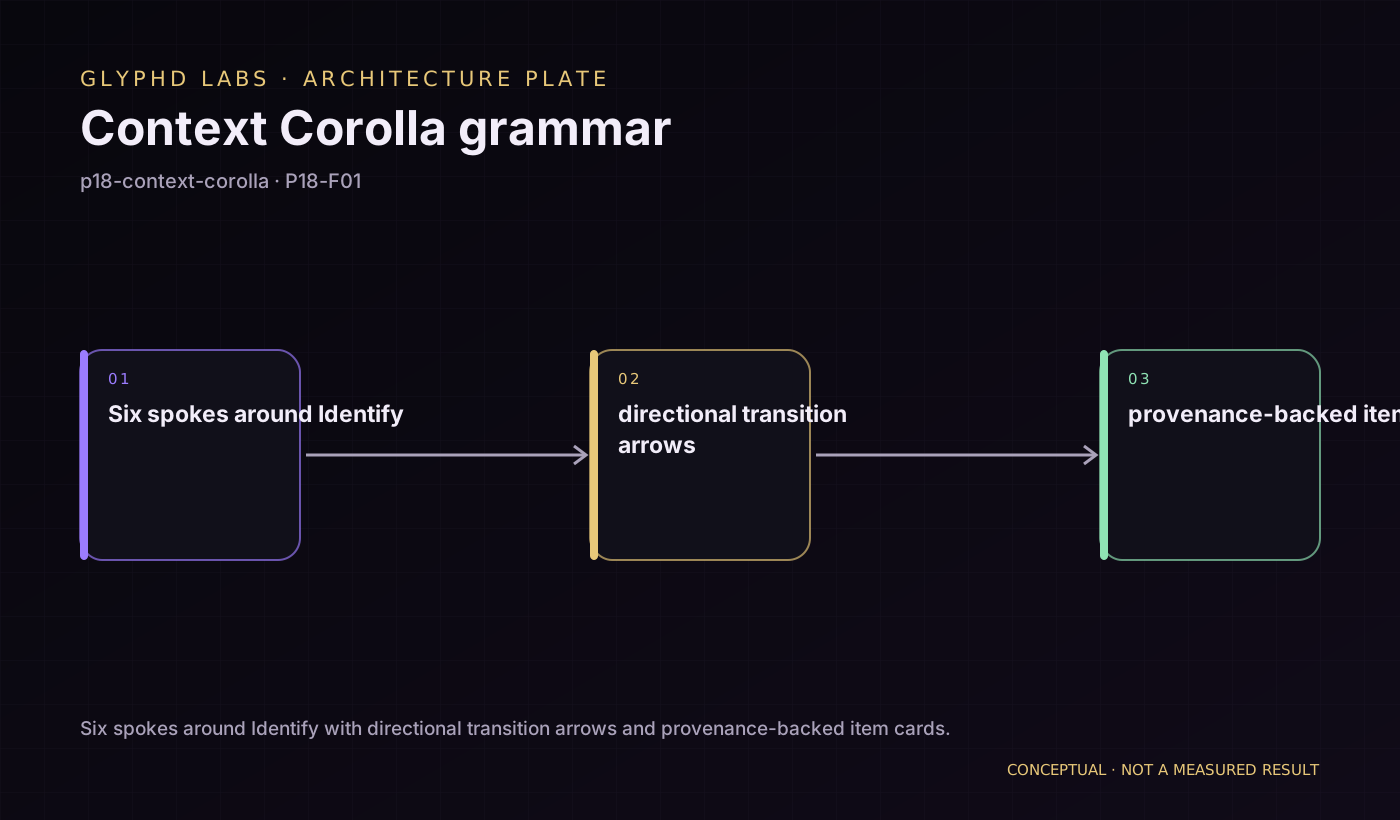
- P18-F01 — Context Corolla grammar: Six spokes around Identify with directional transition arrows and provenance-backed item cards.
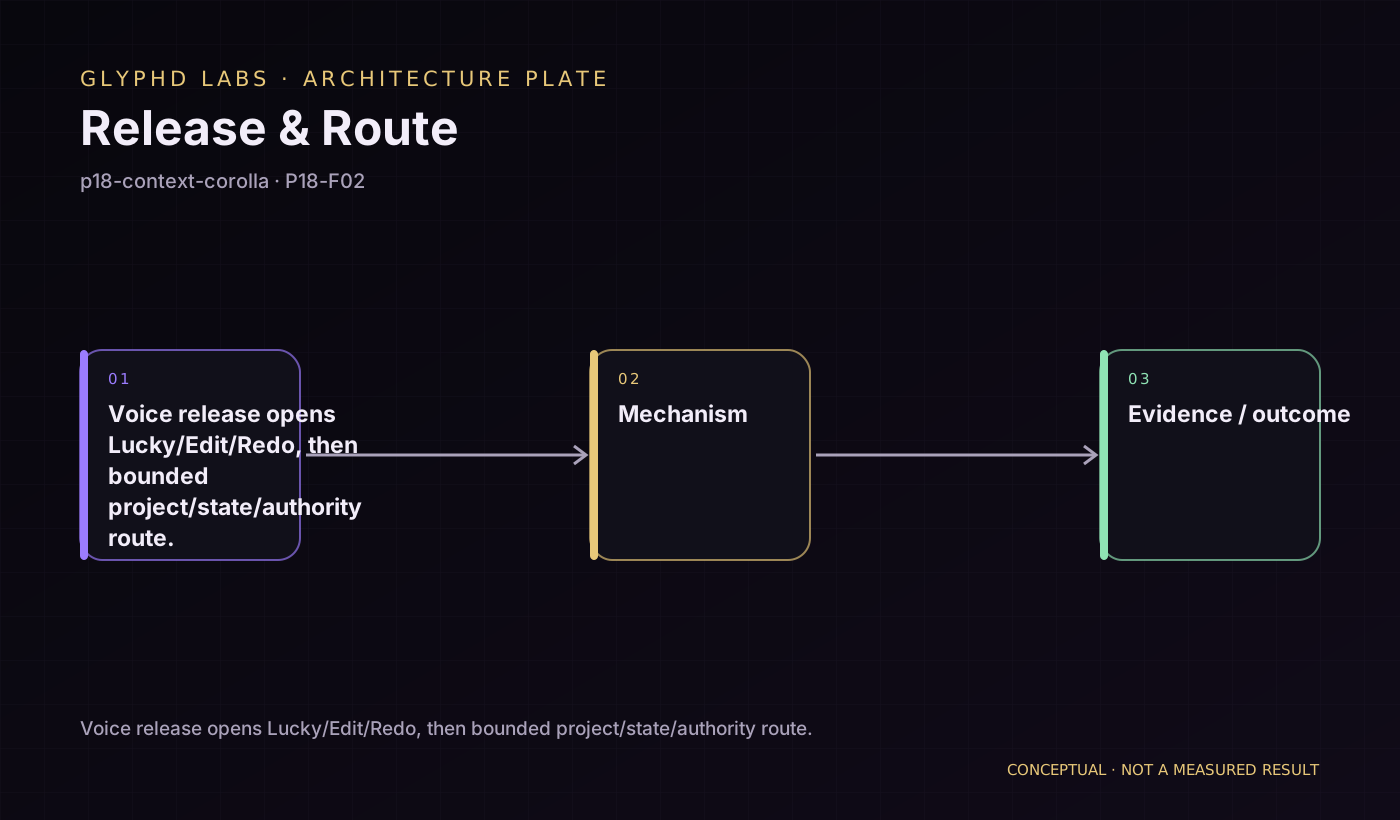
- P18-F02 — Release & Route: Voice release opens Lucky/Edit/Redo, then bounded project/state/authority route.
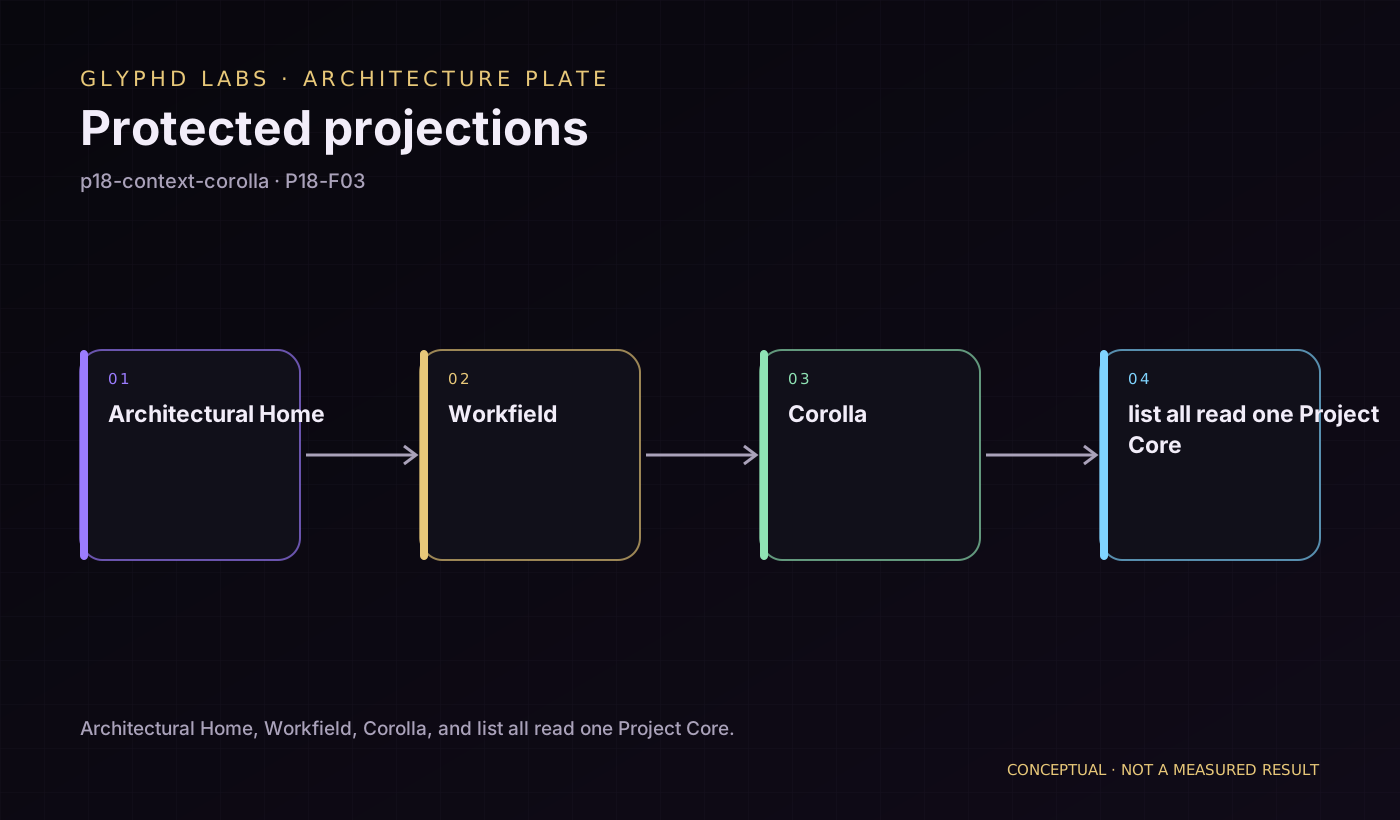
- P18-F03 — Protected projections: Architectural Home, Workfield, Corolla, and list all read one Project Core.
Source register
- P18-S01 — Context Corolla project canon and prototypes (2026-07).
Glyphd project folder / mockups - P18-S02 — Glyphd V1 Canon Recovery and Gap Audit (2026-07-18).
ZEKE-V1-CANON-RECOVERY-AND-GAP-AUDIT-v0.1.md - P18-S03 — Glyphd V1 Master-Spec Locks and Experiment Plan (2026-07-18).
GLYPHD-V1-MASTER-SPEC-LOCKS-AND-EXPERIMENT-PLAN-v0.1.md - P18-S04 — Glyph Desk Master Specification (2026-07-12).
GLYPH-DESK-MASTER-SPEC.v1.md
Public-disclosure and IP boundary
This paper publishes the public-safe interaction grammar and evaluation plan. It excludes private project data, unreleased prototype internals, user voice recordings, and patent-claim language. No productivity uplift is claimed without comparative evidence.
P18-C01IMPLEMENTEDContext Corolla defines a six-state radial projection over Project Core with Identify and Release & Route interactions.
- Exact integrated runtime maturity should be verified in current prototype.
P18-C02SPECIFIEDThe Corolla remains a projection and cannot become a second project database or authority.
- Requires reconstruction and synchronization tests.
P18-C03AWAITING LOCAL RUNThe spatial grammar reduces resumption cost and state confusion relative to lists/Kanban.
- No accepted comparative data is published.
These provenance records identify sources used by the publication. An internal path is not a public download unless a link is explicitly provided.
P18-S01P18-S02P18-S03P18-S04v0.1.0First synthesized public-safe institute edition compiled from the Glyphd project corpus.
This paper publishes the public-safe interaction grammar and evaluation plan. It excludes private project data, unreleased prototype internals, user voice recordings, and patent-claim language. No productivity uplift is claimed without comparative evidence.