
Navigable Temporal Media
Stable addresses for scenes, events, objects, branches, and exact video evidence
Video is usually addressed by file, URL, frame number, or timestamp. Those coordinates are useful for playback but weak for persistent meaning. A scene can move during an edit. An object can appear across shots. A generated clip can be replaced while preserving narrative role. A branch can diverge from one event and later merge. A timestamp says where bytes occur in one representation; it does not necessarily identify the enduring scene, event, object, or state.
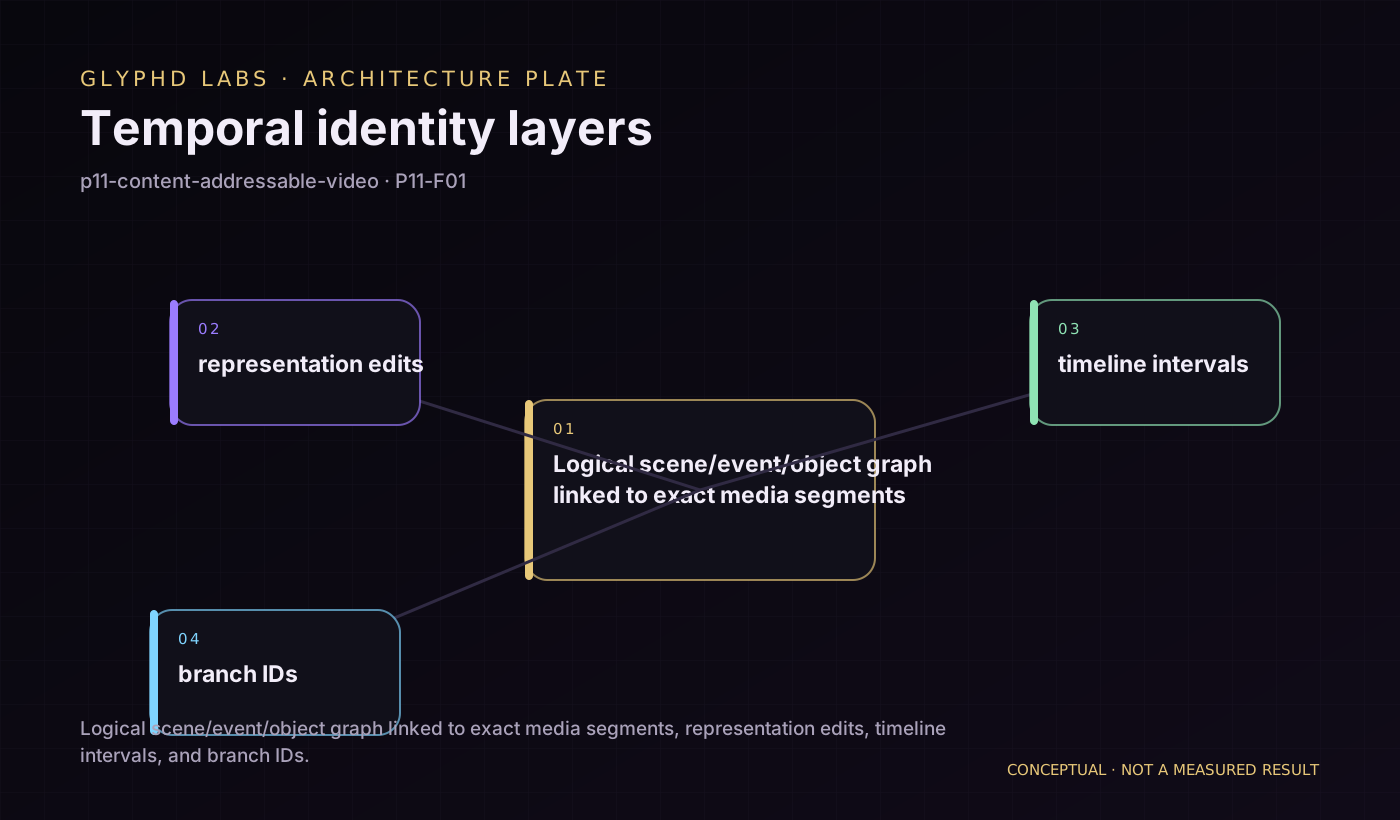
Content-addressable video in the Glyphd program is a layered temporal identity system. Exact media segments retain cryptographic identities. Logical temporal objects—scene, shot, event, actor, prop, state, beat, branch—receive stable IDs and lineage. Representations, edits, generations, proxies, and renders remain distinct. A temporal address can resolve from semantic object to the exact source intervals that currently support it.
The system is not a replacement for codecs. It composes exact media storage, temporal graphs, branch-aware provenance, FOVEA-style multiscale navigation, and fold/2 representation routes. The goal is video that can be cited, revised, regenerated, navigated, and reasoned over without reducing all continuity to one mutable timeline.
Abstract
Video is usually addressed by file, URL, frame number, or timestamp. Those coordinates are useful for playback but weak for persistent meaning. A scene can move during an edit. An object can appear across shots. A generated clip can be replaced while preserving narrative role. A branch can diverge from one event and later merge. A timestamp says where bytes occur in one representation; it does not necessarily identify the enduring scene, event, object, or state.
Content-addressable video in the Glyphd program is a layered temporal identity system. Exact media segments retain cryptographic identities. Logical temporal objects—scene, shot, event, actor, prop, state, beat, branch—receive stable IDs and lineage. Representations, edits, generations, proxies, and renders remain distinct. A temporal address can resolve from semantic object to the exact source intervals that currently support it.
The system is not a replacement for codecs. It composes exact media storage, temporal graphs, branch-aware provenance, FOVEA-style multiscale navigation, and fold/2 representation routes. The goal is video that can be cited, revised, regenerated, navigated, and reasoned over without reducing all continuity to one mutable timeline.
1. The limits of the timestamp
A timestamp identifies a position in one file or stream. It becomes unstable when:
- an intro is added;
- a shot is trimmed;
- a scene is moved;
- a branch replaces the middle act;
- a proxy uses different frame timing;
- a generated shot is rerendered;
- a montage reuses source material;
- several cameras cover one event.
The statement “the red car appears at 01:42” is representation-specific. The underlying claim may be:
object CAR_17
appears in event ARRIVAL_03
during shot SHOT_041
in edit EDIT_V12
supported by exact segment SEGMENT_HASH
Content-addressable temporal media preserves both the semantic object and the exact bytes.
2. Identity layers
Media ContentId
Digest of exact file, segment, frame range, audio range, or chunk DAG.
TemporalObjectId
Stable logical identity for:
- scene;
- sequence;
- shot;
- event;
- beat;
- character;
- prop;
- location;
- state;
- dialogue unit;
- sound cue.
RepresentationId
One encoding, proxy, render, edit, crop, grade, or generated variant.
TimelineAddress
The interval within one representation.
BranchId
The narrative or edit branch in which an object relation applies.
ReceiptId
Proof of ingest, segmentation, edit, generation, replacement, acceptance, or publication.
A scene can remain SCENE_12 while exact content and timestamps change. A particular exact segment remains immutable even if no longer used.
3. Temporal graph
The core object is not only a linear timeline. It is a graph:
Scene
  CONTAINS Shot
Shot
  DEPICTS Event
Event
  INVOLVES Actor/Object
Object
  HAS_STATE_AT Event
Shot
  SUPPORTED_BY ExactSegment
Edit
  ORDERS ShotInstances
Branch
  FORKS_FROM Event/Revision
The graph supports:
- exact source trace;
- continuity queries;
- alternative edits;
- scene replacement;
- object persistence;
- branch comparison;
- provenance;
- regeneration.
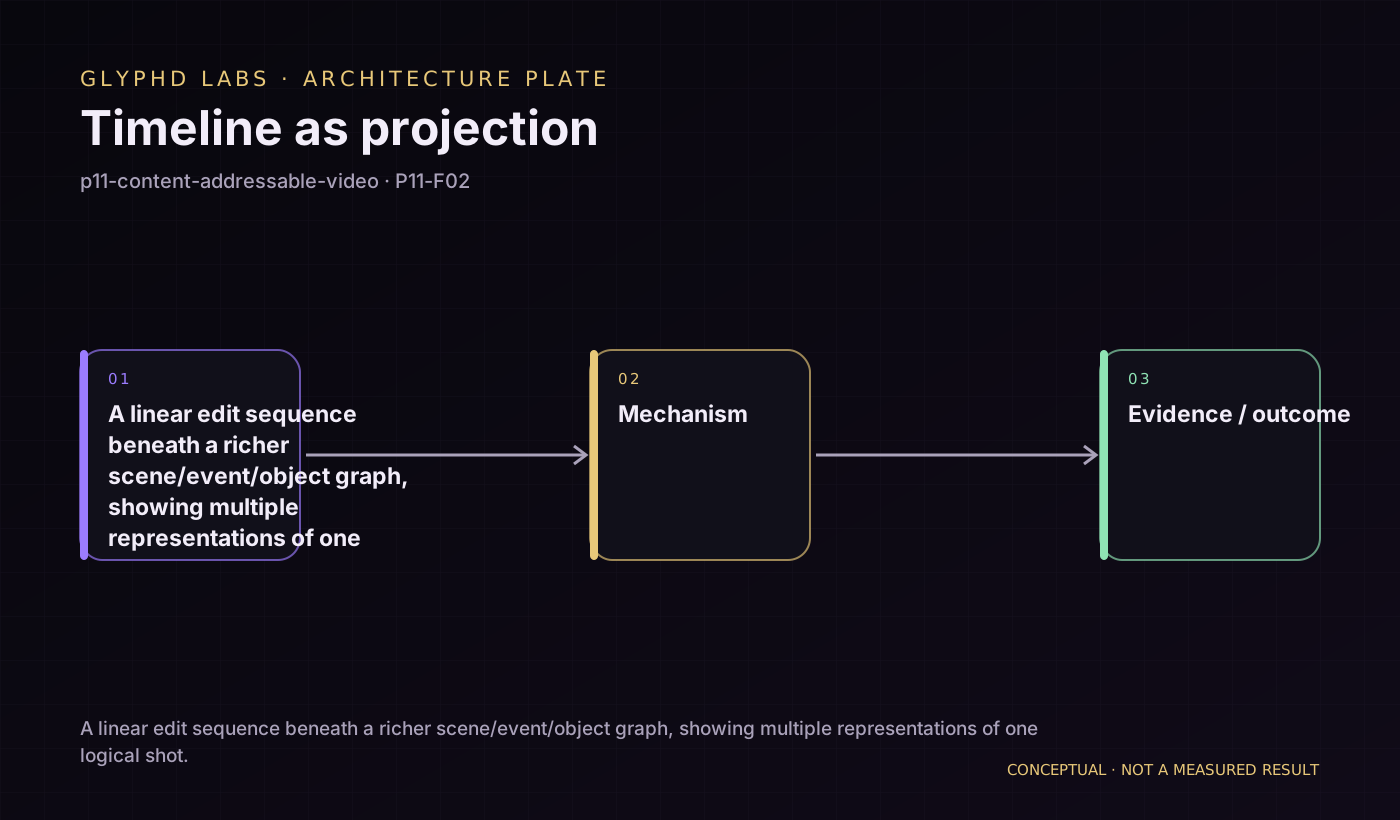
The linear playback sequence is one projection of the graph.
4. Stable temporal addresses
A public-safe temporal address may take a form such as:
video://project/{project}/branch/{branch}/scene/{scene}/event/{event}
Resolution returns:
logical object
current accepted representation
exact supporting segments
timeline intervals
lineage
proof
available branches
staleness
The address does not need to expose private project names publicly. Public publication can use opaque or redacted identifiers.
Addresses should be stable across ordinary edits. A destructive reidentification operation requires an explicit supersession or merge event.
5. Exact segment layer
Exact bytes remain sovereign.
A video object can be chunked by:
- container structure;
- GOP;
- frame ranges;
- scene cuts;
- content-defined boundaries where valid;
- audio segments;
- independently decodable media units.
Each exact segment has:
content_id
media_type
codec
timebase
frame_range
audio_range
parent_file
dependencies
rights
The semantic graph references these exact segments. A claim about what occurs in a scene can resolve to source bytes.
6. Representation and edit lineage
An edit operation creates lineage rather than overwriting:
EditOperation {
  operation_id
  base_edit
  operation_type
  source_refs
  target_interval
  parameters
  result_representation
  actor
  authority
  receipt
}
Operations include:
- trim;
- reorder;
- replace;
- retime;
- crop;
- composite;
- grade;
- audio replace;
- regenerate;
- branch;
- merge.
A current edit is a canonical pointer. Old representations remain addressable under policy.
7. Generated media
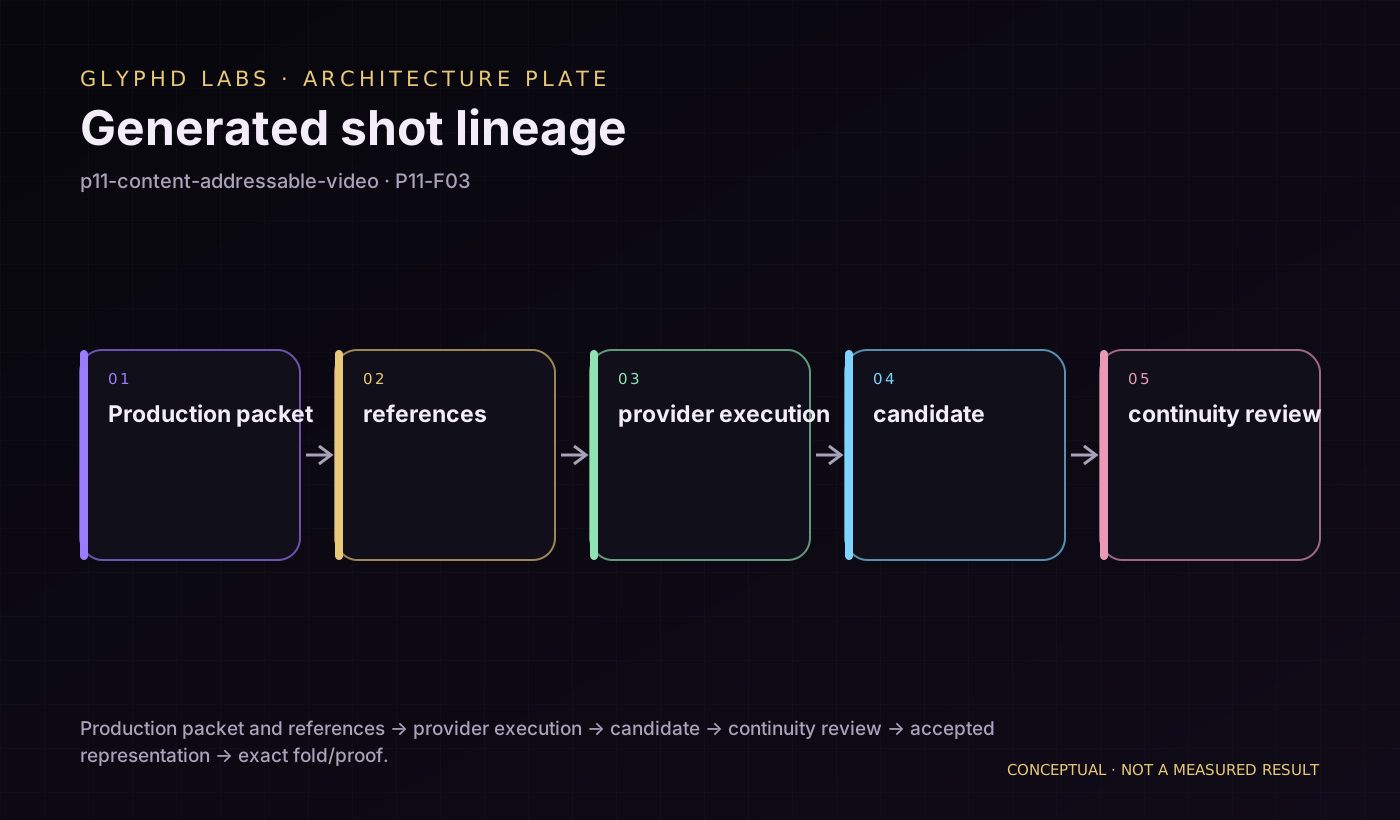
Generated video introduces a second lineage:
prompt / production packet
references
model/provider/runtime
seed and settings
execution capsule
generated representation
review
accepted shot
The production packet may identify:
- shot intent;
- character and object locks;
- camera;
- duration;
- sound posture;
- negative constraints;
- continuity dependencies;
- review rubric.
A generated asset is not canon merely because a provider returned it. It becomes a candidate, is reviewed, and may be accepted as one representation of a logical shot.
fold/2 may encode the accepted bytes through P, D, R, or G routes. Exact media identity remains separate from the recipe.
8. Object persistence
A character or prop can persist across discontinuous shots.
The object graph records observations:
ObjectObservation {
  object_id
  event_id
  shot_id
  exact_segment_ref
  interval
  visible_attributes
  confidence
  source
}
Continuity state may include:
- appearance;
- wardrobe;
- damage;
- location;
- possession;
- emotion;
- lighting;
- spatial relationship;
- unresolved identity.
A model can propose that two observations are the same object. Deterministic IDs and human review govern promotion.
9. Branches and canon
Temporal media often contains alternatives:
- draft cuts;
- alternate endings;
- personal runs;
- creator-curated canon;
- room-voted continuation;
- localized or accessible variants.
A branch declares:
branch_id
parent_branch
fork_event
included edits
policy
audience
status
merge rules
Canon is not equivalent to “latest render.” A project can preserve several branches while one is accepted for a particular audience.
10. Multiresolution navigation
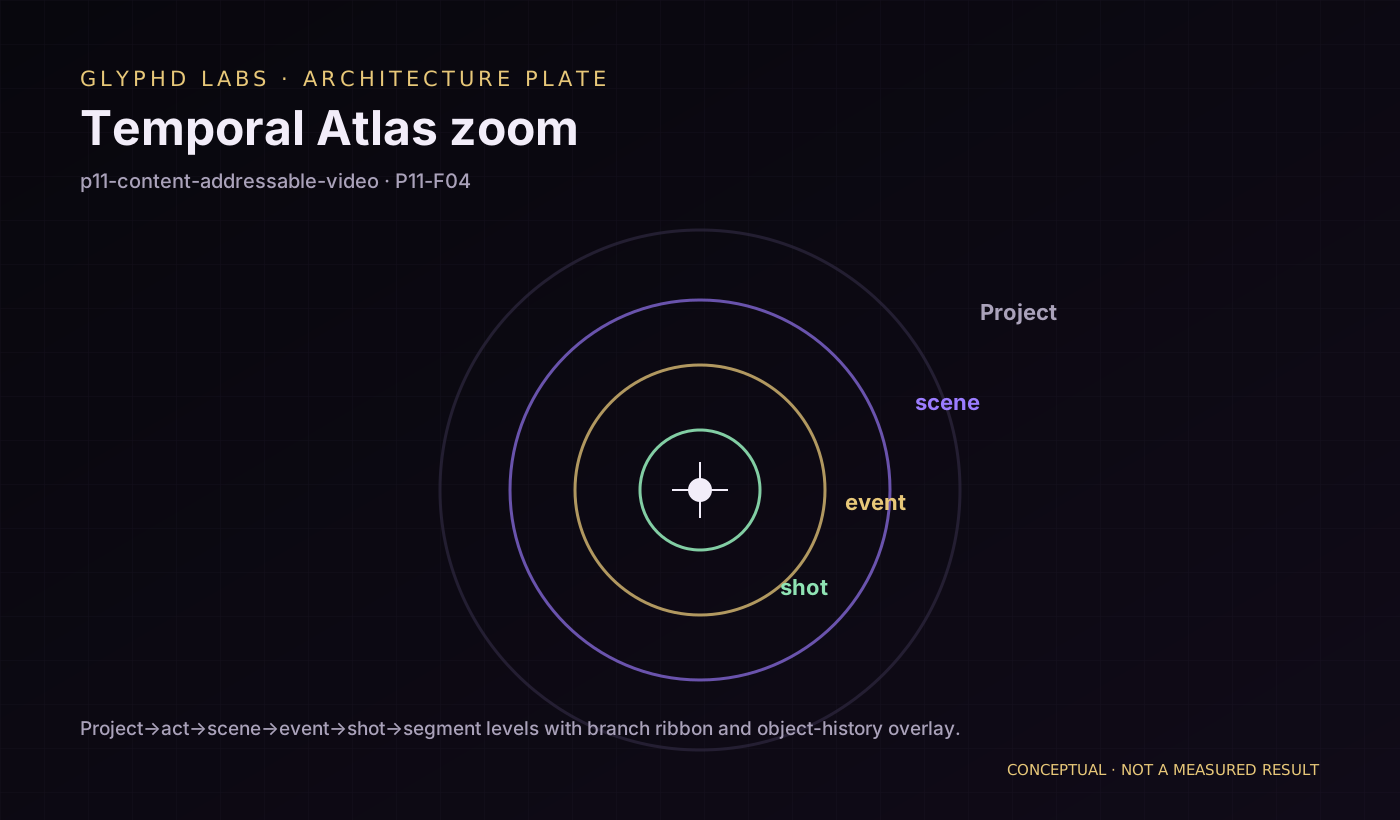
The Temporal Atlas can show:
project
→ act
→ sequence
→ scene
→ event
→ shot
→ frame/segment
At low detail, the user sees scene glyphs and state changes. At high detail, exact frames, audio, prompts, and receipts become available.
A FOVEA-style LOOK can retrieve local temporal neighborhoods:
- active event;
- preceding and following beats;
- object history;
- branch alternatives;
- exact source spans;
- recent edits;
- continuity warnings.
The scrubber remains useful. It is no longer the only address system.
11. Content-addressed editing
An edit request can target a logical object:
replace SHOT_041 in BRANCH_A
preserve EVENT_ARRIVAL
preserve CAR_17 identity
preserve duration window
preserve dialogue sync
The compiler resolves current exact representations and dependencies, prepares a Work Order, and returns a candidate.
This is stronger than “replace 00:42–00:47,” because the operation survives timeline movement and can state what must remain invariant.
12. Evidence and receipts
A public proof page can answer:
- Which exact segment supports this scene?
- Who created or generated it?
- Which references influenced it?
- What edit placed it here?
- Which branch includes it?
- Was it accepted?
- What changed from the prior version?
- Which continuity checks passed?
- Are rights or attribution attached?
Receipts should not publish confidential prompts or private people by default. They can expose digests and public-safe metadata.
13. Compression relationship
Content addressing and compression are separate.
Potential storage gains include:
- exact segment deduplication;
- prior-version deltas;
- shared dictionaries;
- recipe regeneration;
- residual correction;
- proxy representations;
- model-conditioned output coding.
The temporal graph adds metadata. It can make editing and retrieval cheaper even when total stored bytes increase.
No claim is made that semantic video addressing beats AV1 or any mature codec on arbitrary camera footage.
14. Demonstration
A browser Temporal Atlas can use deterministic fixtures:
- three scenes;
- recurring actor and prop;
- two edit branches;
- exact mock segment hashes;
- one regenerated candidate;
- continuity state changes;
- receipts.
The user can switch between timeline, scene graph, object history, and branch lineage. Selecting an event reveals exact supporting intervals.
The demo teaches the address grammar without claiming real video-model performance.
15. Benchmark program
Identity correctness
- stable scene IDs across reorder;
- exact segment integrity;
- no timestamp/identity conflation;
- branch lineage;
- object merge/split accuracy;
- stale-reference detection.
Navigation
- time to find event;
- time to find every appearance of an object;
- refind after edit;
- branch comparison;
- exact source recovery.
Editing
- address-stable replacement;
- preserved constraints;
- continuity violations;
- provenance completeness;
- rollback.
Storage and compute
- dedup;
- delta;
- dependency-adjusted bytes;
- regeneration cost;
- random access;
- graph overhead;
- proxy latency.
16. Security, rights, and privacy
Video may contain faces, voices, locations, private events, copyrighted media, and sensitive metadata.
The system requires:
- rights and consent attached to assets;
- access control by object and branch;
- redacted public addresses;
- no identity inference promoted without review;
- revocable sharing;
- audit of derived and generated media;
- protection against malicious media parsers;
- provenance without exposing private prompts;
- explicit synthetic or altered-media labels.
17. Evidence state
The corpus contains OOC-V specifications, temporal-media architecture, proof mechanisms, video-production packet systems, world-building canon structures, and content-addressed representation concepts. The mechanism suite establishes exact representation and recipe/residual foundations.
A complete production implementation with real video ingestion, object identity, branch editing, and benchmark results remains SPECIFIED or HYPOTHESIS by component.
18. Limitations
Semantic segmentation and object tracking are uncertain. Human review may be required. Stable IDs can become difficult when scenes merge or objects are ambiguous. Graph metadata can be large. Rights metadata can be incomplete. Generated-media regeneration can drift.
The system also risks over-formalizing creative editing. Artists should be able to work fluidly and attach structure progressively.
19. Conclusion
Video should remain playable as a timeline. It should also become addressable as a world of persistent objects, events, branches, and exact evidence.
The central proposition is:
A timestamp finds a moment in one representation. A temporal address finds the enduring object and then resolves the exact moment that currently represents it.
Architecture illustration briefs
- P11-F01 — Temporal identity layers: Logical scene/event/object graph linked to exact media segments, representation edits, timeline intervals, and branch IDs.
- P11-F02 — Timeline as projection: A linear edit sequence beneath a richer scene/event/object graph, showing multiple representations of one logical shot.
- P11-F03 — Generated shot lineage: Production packet and references → provider execution → candidate → continuity review → accepted representation → exact fold/proof.
- P11-F04 — Temporal Atlas zoom: Project→act→scene→event→shot→segment levels with branch ribbon and object-history overlay.
Source register
- P11-S01 — OOC-V specification and fractal-video workspace (2026-07).
fractal-video.zip / OOC-V-SPEC-v0.1.md - P11-S02 — GlyphDrive/FOVEA/OOC Technical Assessment (2026-07-12).
GLYPHDRIVE-FOVEA-OOC-TECHNICAL-ASSESSMENT-v0.2-PLANNING.md - P11-S03 — GlyphDrive OOC fold/2 Specification (2026-07-12).
GLYPHDRIVE-OOC-FOLD-SPEC-v0.2.md - P11-S04 — VideoWorlds and TextPilot canon corpus (2026-06/07).
VideoWorlds project folder - P11-S05 — X-Splora production skills and shot-packet notes (2026-06-30).
Pasted markdown.md
Public-disclosure and IP boundary
This paper publishes the public-safe temporal identity and navigation architecture. It excludes confidential media, private likeness data, unreleased model prompts, proprietary generation recipes, and patent-claim drafting. It makes no claim of codec superiority over AV1 or other mature media codecs.
P11-C01SPECIFIEDExact media segments, logical temporal objects, representations, timeline intervals, and branches can be represented as separate linked identities.
- Integrated media graph implementation remains incomplete.
P11-C02VERIFIED MECHANISMRecipe and residual mechanisms provide an exact representation path for generated media under pinned dependencies.
- Real video pipeline conformance is not established.
P11-C03HYPOTHESISStable scene/event/object addressing improves editing and retrieval across revisions compared with timestamp-only workflows.
- No accepted user benchmark is published.
These provenance records identify sources used by the publication. An internal path is not a public download unless a link is explicitly provided.
P11-S01P11-S02P11-S03P11-S04P11-S05v0.1.0First synthesized public-safe institute edition compiled from the Glyphd project corpus.
This paper publishes the public-safe temporal identity and navigation architecture. It excludes confidential media, private likeness data, unreleased model prompts, proprietary generation recipes, and patent-claim drafting. It makes no claim of codec superiority over AV1 or other mature media codecs.