
The Future Is Foveated
Deterministic addressing, procedural landmarks, and evidence-bound navigation
Large information systems are typically navigated by names, search results, folders, timelines, and lists. These are effective but force every return to begin as a query or a reconstruction of hierarchy. Human beings also remember by place, neighborhood, landmark, scale, and relative position. FOVEA proposes a deterministic address fabric that gives digital objects stable place, procedurally generated navigational identity, and attention-proportional retrieval without turning the spatial projection into the source of truth.
FOVEA uses an exact dyadic quadkey lattice, Hilbert linearization for locality-preserving storage and traversal, receipt-bound placement, deterministic landmarks, a single LOOK observation primitive, and concentric retrieval budgets around an active reticle. Canonical state remains in LCSM. Encoded object representation remains in fold/2. FOVEA owns placement, address mathematics, locality, navigation, and bounded retrieval.
The strongest current claim is infrastructural: the supplied address implementation and proof deck establish coherent exact addressing, traversal, reconstruction, and corruption-handling mechanisms. The central cognitive claim—that procedural landmarks make a recursive information field more memorable and useful than an ordinary grid or competent search interface—remains deliberately falsifiable through named kill criteria.
Abstract
Large information systems are typically navigated by names, search results, folders, timelines, and lists. These are effective but force every return to begin as a query or a reconstruction of hierarchy. Human beings also remember by place, neighborhood, landmark, scale, and relative position. FOVEA proposes a deterministic address fabric that gives digital objects stable place, procedurally generated navigational identity, and attention-proportional retrieval without turning the spatial projection into the source of truth.
FOVEA uses an exact dyadic quadkey lattice, Hilbert linearization for locality-preserving storage and traversal, receipt-bound placement, deterministic landmarks, a single LOOK observation primitive, and concentric retrieval budgets around an active reticle. Canonical state remains in LCSM. Encoded object representation remains in fold/2. FOVEA owns placement, address mathematics, locality, navigation, and bounded retrieval.
The strongest current claim is infrastructural: the supplied address implementation and proof deck establish coherent exact addressing, traversal, reconstruction, and corruption-handling mechanisms. The central cognitive claim—that procedural landmarks make a recursive information field more memorable and useful than an ordinary grid or competent search interface—remains deliberately falsifiable through named kill criteria.
1. A map for information, not a database in disguise
The common metaphor for large digital information is a container:
- a file system;
- a folder tree;
- a database;
- a feed;
- a list of search results;
- a sequence of chat messages.
Each container imposes a navigation grammar. Folder trees require path knowledge. Search requires the user to formulate a query. Feeds privilege recency or ranking. Chat history privileges chronology. None is wrong, but each is weak at preserving a durable sense of where an idea lives.
FOVEA asks a different question:
What if information could retain stable place, neighborhood, and landmark identity while remaining a projection over a separate truth system?
The answer must avoid three traps.
First, the map cannot become a second database. If its storage is corrupted or deleted, canonical truth must remain reconstructable.
Second, geometry cannot be used as a mystical explanation for compression or intelligence. Placing arbitrary data on a fractal does not reduce the data.
Third, a visually striking field is not automatically useful. Spatial memory, peripheral awareness, retrieval cost, and user preference must be measured against serious non-spatial baselines.
2. Category definition
FOVEA is a deterministic, recursively subdividable coordinate manifold used as a visual and retrieval index over evidence-bound objects.
It produces three primary capabilities:
- Stable place. An object can receive a durable address that does not change merely because adjacent content grows.
- Procedural landmarks. A field can acquire unique visual identity from a compact seed and deterministic skin rather than stored artwork for each cell.
- Attention-proportional retrieval. The system loads exact local detail near the active focus and progressively coarser context farther away.
The public program is named FOVEA Address Fabric. Earlier materials used GlyphDrive as a product or umbrella working name. That name remains private or historical pending clearance.
3. Exact address authority
The v0.2 address authority is a dyadic quadkey lattice.
An address is a base-4 string over:
0 = northwest
1 = northeast
2 = southwest
3 = southeast
Depth is the string length. The current implementation contract is bounded to a maximum depth, rather than falsely claiming literal mathematical infinity in code.
Address arithmetic is exact. Integer and rational operations determine placement, parent, child, neighbor, and local offset. Floating-point interpolation may be used for rendering, but it cannot define canonical placement.
Core invariants include:
- permanence: once a placement is receipted, content may supersede but the historical address does not silently move;
- purity: address arithmetic requires no I/O, clock, network, or model;
- proof binding: an address without a proof pointer is decorative;
- observational determinism: the same LookState produces the same logical frame;
- identity separation: address is place, not logical object identity, exact content identity, or encoded representation identity.
This separation prevents a subtle class of corruption. If an object changes version, its logical continuity may remain, its exact content hash changes, its fold/2 representation may change, and its stable place may remain. Those are four legitimate identities.
4. Hilbert locality
A two-dimensional field must often be stored and fetched through one-dimensional ranges. Row-major ordering creates large discontinuities between spatial neighbors. A Hilbert curve maps the recursive grid into a one-dimensional order while preserving locality better than simple row-major traversal.
FOVEA uses Hilbert linearization for:
- storage ordering;
- bounded range fetch;
- prefetch;
- neighborhood traversal;
- audit walks;
- local cache organization.
Hilbert order is not the visual identity of the object and is not the canonical address. It is an operational ordering derived from the address.
The design allows a viewport to request contiguous or nearly contiguous ranges corresponding to spatially local neighborhoods. Whether this produces meaningful end-to-end gains depends on storage layout, object size, cache policy, and comparison with competent lazy-loading systems. That is a benchmark question, not a theorem of the interface.
5. Receipt-bound placement
A FOVEA placement is a ledger event, not a freehand drawing operation.
A placement record resolves:
logical_object_ref
exact_content_ref
spatial_address
placement_operation
prior_placement?
proof_receipt
timestamp
projection_hint?
The visual layer may show a canon rim, proof mark, breach state, or uncertainty treatment. Those indicators derive from receipt classes and validation state. A render hint cannot draw itself into trusted status.
Three hard laws follow:
- Total reconstruction. The atlas is rebuildable from the canonical journal.
- One-way dependency. Canonical objects do not require the atlas address for identity or truth.
- No trusted unfold without proof. Missing or failed proof renders as a breach and cannot masquerade as accepted content.
A practical test is severe and simple:
rm -rf atlas/
rebuild from journal
compare logical atlas state
If truth is lost, FOVEA has violated its category.
6. LOOK
FOVEA attempts to keep the operational verb set small. LOOK is the central observation primitive.
A LookState may contain:
center_address
depth
reticle_offset
viewport
active_ring_budgets
projection_skin
time_or_branch
proof_policy
Given the same state and canonical inputs, the logical result should be deterministic. The renderer may animate transitions, but the object selection, ring classes, and proof condition must remain inspectable.
The one-verb design is intentionally vulnerable to falsification. If real usage requires multiple unrelated retrieval verbs merely to make the field usable, the claim that FOVEA provides a coherent observation primitive weakens.
7. Foveation rings
FOVEA divides the field around the reticle into retrieval classes:
- foveal: exact local detail and active object state;
- parafoveal: nearby objects, summaries, and interaction affordances;
- peripheral: glyphs, landmarks, status signals, and coarse structure;
- outside: unloaded or represented only by aggregate metadata.
A scheduler can:
- classify visible addresses by ring;
- compare desired classes with loaded classes;
- enqueue exact detail from the fovea outward;
- order local work by Hilbert position;
- enforce per-ring byte, token, or object budgets;
- prefetch along reticle motion during idle time;
- evict low-value detail after exit.
The retrieval policy should be receipt-shaped: a diagnostic record can explain what was loaded, omitted, evicted, and why.
The goal is not merely fewer bytes. It is to move the smallest sufficient neighborhood while preserving orientation and proof.
8. Procedural landmarks
A recursive grid becomes difficult to remember if every region looks interchangeable. FOVEA generates visual landmarks from address prefixes, a field seed, and a skin function.
A landmark may influence:
- texture;
- line rhythm;
- hue family;
- local topology;
- boundary motifs;
- glyph shape;
- density;
- named macro-regions.
The surface is cheap because the identity is generated, not stored per cell. This is a real storage property of the navigational surface itself.
It is not compression of pinned user data.
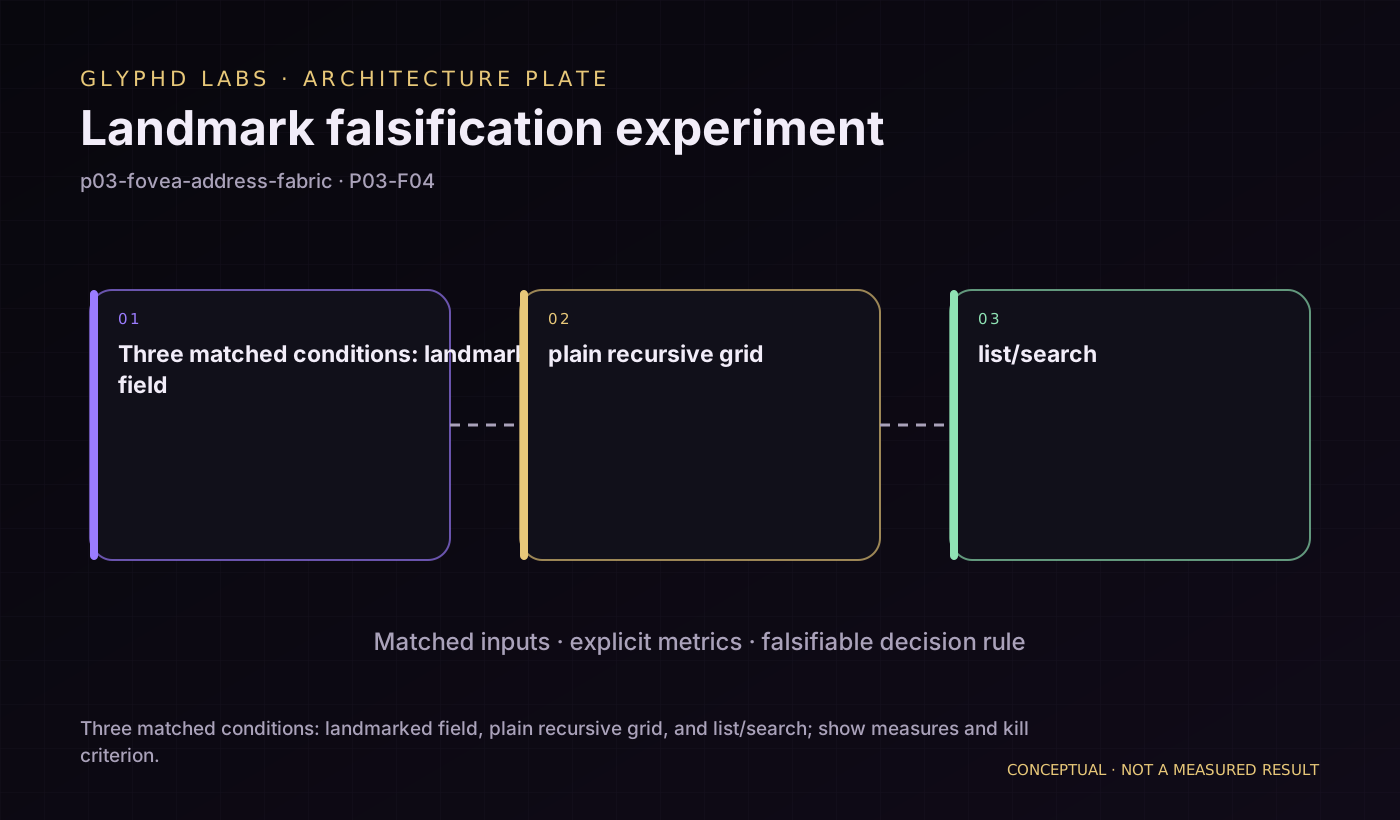
The central HCI hypothesis is that procedural landmarks provide spatial memory and peripheral recognition beyond what a plain grid offers. The correct experiment compares:
A: recursive address field with deterministic landmarks
B: identical recursive field without landmarks
C: conventional list/search baseline
The test measures refind time, navigation errors, awareness of peripheral change, and subjective ownership after repeated use.
9. Peripheral glyphs
At low detail, an object should not become meaningless visual noise. A peripheral glyph can encode a bounded abstract:
object class
status
proof state
staleness
activity
uncertainty
relationship direction
attention request
The glyph is a projection. It cannot substitute for exact content. Selecting or approaching it increases detail until the exact source or verified surface becomes available.
This allows the field to preserve more global context than a full-detail interface while remaining honest about what has been omitted.
10. What FOVEA does and does not save
A public claims ledger is essential.
Real or plausible savings
- procedural generation of the map and landmarks;
- compact prefix-shared address representation;
- locality-preserving range retrieval;
- pointer-sized peripheral objects instead of full payloads;
- attention-scaled loading;
- reduced prompt or context movement when the active neighborhood is smaller than the corpus.
Not a FOVEA claim
- arbitrary data becomes smaller because it is placed on a fractal;
- semantic truth emerges from geometry;
- a visual field replaces search;
- a recursive atlas is inherently faster on every workload;
- the map is memory;
- the map is the codec.
Compression belongs to fold/2, dictionaries, deltas, content-defined chunks, model-conditioned coding, or media codecs. FOVEA can help select context or order retrieval, but it must not receive credit for bytes saved by another lane.
11. Implementation evidence
The inspected material includes:
- a dependency-free address implementation;
- base-4 quadkeys;
- parent, child, and neighbor operations;
- exact rational offsets;
- Hilbert linearization;
- deterministic URI parsing and formatting;
- deterministic derived placement;
- a browser proof deck.
The proof-deck core was extracted and executed in Node in the recorded assessment. Twelve of twelve self-tests passed, including address and Hilbert invariants, exact fold round trips, boundary verification, corruption refusal, conditioned sample behavior, recipe regeneration, residual reconstruction, and seed-drift failure.
The broader Rust source contains additional address and codec tests. In the cited assessment environment, those Rust tests were source-reviewed but not independently executed because the toolchain was absent. They must remain SOURCE_REVIEWED until an exact-head Rust receipt exists.
The evidence establishes mechanism coherence. It does not establish the cognitive value of the map or production performance.
12. Kill criteria
FOVEA is designed to be killed if its core claims fail.
K1 — Spatial memory does not transfer
After repeated use, place-remembered refind is not better than search or ordinary navigation on the same corpus.
K2 — Address churn
Real growth requires frequent address migration or rebalancing, defeating stable place.
K3 — Dead periphery
Peripheral cues are not noticed or acted on above chance or useful baseline rates.
K4 — The fractal is removable
Landmarked recursion offers no measurable advantage over a plain quadtree grid.
K5 — Foveation does not pay
Bytes or tokens moved improve by less than the declared threshold versus a competent lazy-loading baseline without unacceptable quality loss.
K6 — Verb creep
The single-observation model proves inadequate and requires a collection of unrelated retrieval operations.
K7 — Proof theater
Any path displays unverified content as trusted.
K8 — Regeneration drift
Procedurally represented objects fail digest checks at material rates and the claimed storage path cannot survive conformance.
The existence of kill criteria is part of the technology. A research program that cannot state what would falsify it is a visual concept, not an engineering discipline.
13. Benchmark contract
The first complete benchmark family should include:
Address conformance
- parse/format round trips;
- parent/child inverse properties;
- neighbor boundary behavior;
- exact rational offsets;
- depth limits;
- URI normalization;
- Hilbert golden vectors;
- deterministic placement;
- cross-language parity.
Reconstruction
- delete projection cache;
- replay journal;
- compare object/address/proof relations;
- inject corruption and missing receipts;
- ensure breach rendering and refusal.
Retrieval
- bytes, objects, and tokens moved;
- latency to exact local evidence;
- cache hit and eviction;
- modern lazy-loading baseline;
- search/list baseline;
- corpus size scaling;
- branch and time restoration.
Cognition
- place-memory refind;
- named-item search;
- peripheral change awareness;
- landmark versus plain-grid A/B;
- learning curve;
- accessibility;
- motion sensitivity;
- user preference and perceived ownership.
14. Security and privacy
Spatial memory can reveal relationships even when payloads remain hidden. A field layout may expose that two private projects are near, active, or related. Therefore:
- placement visibility must follow object visibility;
- public and private atlases require separate projection policies;
- shared screenshots must redact hidden neighborhoods;
- addresses must not become capabilities unless explicitly designed as unguessable tokens;
- proof references must not leak confidential source paths;
- procedural skins must not encode secrets;
- renderer caches must be purgable without losing canonical state;
- external models receive only a bounded context manifest.
FOVEA must also resist malicious address depth, pathological neighborhood expansion, oversized glyph metadata, and proof spoofing.
15. Limitations
The cognitive hypothesis is unproven. Spatial interfaces can become disorienting, inaccessible, or slower than lists for users who prefer language and search. A stable address can preserve location while the conceptual meaning of a project changes, creating semantic mismatch.
Hilbert ordering improves locality in a mathematical sense but does not guarantee application performance. Real gains depend on backend storage, object distribution, and access patterns.
Procedural landmarks may be memorable for some users and distracting for others. Accessibility equivalents must preserve full operation through lists, keyboard navigation, text search, and screen-reader structure.
The current maximum depth is finite. Public language must say “deep recursive addressing” or state the implemented limit, not literal infinity.
16. Conclusion
FOVEA is not a claim that knowledge naturally forms a fractal. It is a disciplined address and attention layer.
Its core proposition is:
Truth can remain in a canonical ledger while information acquires stable place, procedural landmarks, and a bounded local working set.
If the landmarks fail, remove them. If foveation does not beat modern loading, abandon the efficiency claim. If proof can be painted rather than verified, stop the line.
The ambition survives this severity because the underlying problem is real. Human beings need more than larger search boxes and longer transcripts. They need places to return to—provided those places remain honest projections of truth rather than beautiful substitutes for it.
Architecture illustration briefs
- P03-F01 — FOVEA lane boundary: Three-column system: LCSM truth, FOVEA address/lens, fold/2 representation. Arrows cross only through Gantry; no reverse authority from the map.
- P03-F02 — Quadkey and Hilbert atlas: Recursive 4-way subdivision with addresses and an overlaid Hilbert traversal, showing stable place versus derived storage order.
- P03-F03 — Foveation rings: Reticle-centered rings showing exact local content, nearby summaries, peripheral glyphs, and unloaded outer field with byte/token budgets.
- P03-F04 — Landmark falsification experiment: Three matched conditions: landmarked field, plain recursive grid, and list/search; show measures and kill criterion.
Source register
- P03-S01 — GlyphDrive FOVEA Specification v0.2 (2026-07-12).
GLYPHDRIVE-FOVEA-SPEC-v0.2.md - P03-S02 — GlyphDrive/FOVEA/OOC Technical Assessment and v0.2 Research Plan (2026-07-12).
GLYPHDRIVE-FOVEA-OOC-TECHNICAL-ASSESSMENT-v0.2-PLANNING.md - P03-S03 — GlyphDrive FOVEA Specification v0.1 (2026-07-10/12).
GLYPHDRIVE-FOVEA-SPEC-v0.1.md - P03-S04 — GlyphDrive v0.2 Ratification Gate R0 (2026-07-12).
PASTE-INTO-OPUS-GLYPHDRIVE-V02-RATIFICATION-R0.md - P03-S05 — Zeke 4B Max-Flex Runtime Master Spec (2026-07-15).
ZEKE-4B-MAXFLEX-RUNTIME-MASTER-SPEC-v0.1.md
Public-disclosure and IP boundary
This paper publishes the public-safe architecture, invariants, evidence state, and falsification criteria. It does not publish confidential placement heuristics, private corpus layouts, patent-claim language, or unreleased optimization details. FOVEA is not presented as a cleared public trademark for the earlier GlyphDrive working name, and no general compression claim is made.

P03-C01VERIFIED MECHANISMThe FOVEA source implements coherent deterministic quadkey, neighborhood, exact-offset, Hilbert, and URI mechanisms.
- Cross-language and exact-head Rust execution still require a current receipt.
P03-C02SPECIFIEDA FOVEA atlas can be treated as a reconstructable materialized projection rather than canonical truth.
- Production replay implementation must be tested.
P03-C03HYPOTHESISProcedural landmarks improve spatial memory and peripheral awareness over a plain recursive grid.
- No qualifying controlled A/B is published.
P03-C04HYPOTHESISFoveated retrieval can reduce context movement relative to competent lazy loading while preserving exact proof.
- The ≥2× gate remains unrun in an accepted benchmark.
These provenance records identify sources used by the publication. An internal path is not a public download unless a link is explicitly provided.
P03-S01P03-S02P03-S03P03-S04P03-S05v0.1.0First synthesized public-safe institute edition compiled from the Glyphd project corpus.
This paper publishes the public-safe architecture, invariants, evidence state, and falsification criteria. It does not publish confidential placement heuristics, private corpus layouts, patent-claim language, or unreleased optimization details. FOVEA is not presented as a cleared public trademark for the earlier GlyphDrive working name, and no general compression claim is made.