
Generating Language Is Not the Same as Doing What the Language Says
The manifestation gap and the case for stateful latent objects in general AI assistance
Language models can describe a plan, simulate the voice of an expert, enumerate the steps of a build, and announce that work is complete without any necessary change occurring in the world that the language describes. This is not a minor product defect. It is a category error created by treating linguistic plausibility as operational progress.
This paper names that error the manifestation gap: the distance between generated language and the observable, persistent, inspectable state that would make the language true. The proposed response is a general architecture in which an intelligent system must manifest a latent object alongside its language. The object may be an artifact, a state transition, a decision graph, a simulation, a verified operational surface, a test result, a receipt, a changed file tree, or an explicitly preserved uncertainty. What matters is that it has identity, state, lineage, acceptance conditions, and a visible relationship to the stated goal.
The central claim is not that every response must create a document or run a tool. It is that every consequential interaction should answer: what is being manifested, how can its progress be observed, and what would count as truthfully complete? This reframes the general assistant from a sequence generator into a participant in a shared human world. Language becomes one projection of a governed object rather than the object itself.
Abstract
Language models can describe a plan, simulate the voice of an expert, enumerate the steps of a build, and announce that work is complete without any necessary change occurring in the world that the language describes. This is not a minor product defect. It is a category error created by treating linguistic plausibility as operational progress.
This paper names that error the manifestation gap: the distance between generated language and the observable, persistent, inspectable state that would make the language true. The proposed response is a general architecture in which an intelligent system must manifest a latent object alongside its language. The object may be an artifact, a state transition, a decision graph, a simulation, a verified operational surface, a test result, a receipt, a changed file tree, or an explicitly preserved uncertainty. What matters is that it has identity, state, lineage, acceptance conditions, and a visible relationship to the stated goal.
The central claim is not that every response must create a document or run a tool. It is that every consequential interaction should answer: what is being manifested, how can its progress be observed, and what would count as truthfully complete? This reframes the general assistant from a sequence generator into a participant in a shared human world. Language becomes one projection of a governed object rather than the object itself.
1. The problem: language can impersonate completion
A language model is optimized to continue a sequence. It can produce text with the surface form of a design review, a proof, a work order, a laboratory report, a deployment receipt, or a final answer. The generated form may be excellent. Yet the correspondence between that form and an external state is optional unless a surrounding system makes it mandatory.
The failure appears in ordinary use:
- a model writes “the repository is ready” without inspecting the current branch;
- an agent writes “tests passed” because that sentence fits the expected report;
- a planning assistant produces a road map whose tasks have no durable identity;
- a chat generates ten versions of a decision, leaving the human to remember which one was accepted;
- a creative model describes a coherent film while no shot packet, asset map, or continuity state is produced;
- a research assistant gives a persuasive interpretation while the source, experiment, and limitations remain unbound;
- an application shows animated progress while no work event occurred.
These are different manifestations of one structural problem: the machine can generate the language of an event without participating in the event.
Humans do not normally evaluate progress only by the sentences spoken about it. We use changed objects, time, position, evidence, commitments, social consequences, working prototypes, physical movement, and the accumulating shape of a task. We know a house is being built because a foundation exists, materials arrive, inspections occur, and the incomplete structure changes. We know a paper is advancing because claims, sources, experiments, figures, and revisions become more complete and more constrained. We know a promise was kept because the promised state can be inspected.
A chat transcript contains traces of thought, but it is a poor substitute for the thing being thought into existence. It makes the human reconstruct the object mentally from language distributed across turns. That reconstruction burden grows with project length, provider count, number of agents, and time between sessions.
2. The latent object
A latent object is the durable, structured thing whose state gives meaning to the language surrounding it.
“Latent” does not mean hidden from inspection. It means the object may begin as an incomplete possibility before it becomes a final artifact. A software feature exists first as a bounded intent, then a work order, a branch, changed files, test evidence, a review, and an accepted release. A research claim exists first as a hypothesis, then a method, run artifacts, interpretation, and a publication state. A decision exists first as alternatives, then an accepted constraint and its consequences.
A latent object has at least the following properties:
- Identity. The system can distinguish this object from another object and recognize it across sessions and projections.
- State. It has a current condition that is not inferred solely from the latest prose.
- Lineage. Its current state can be traced to prior states, sources, decisions, and actions.
- Boundary. The system can state what belongs to the object and what does not.
- Authority. It records who may propose, authorize, execute, accept, revise, publish, or revoke changes.
- Evidence. Claims about the object can resolve to sources, tests, observations, or receipts.
- Projection. It can be rendered differently for discussion, planning, execution, inspection, or public presentation without creating multiple truths.
- Completion contract. There is an explicit condition under which the object may be called complete, accepted, verified, or released.
- Persistence. It survives the end of a model call, chat session, provider, interface, or device.
- Failure state. It can remain blocked, failed, disputed, stale, or unknown without being narratively smoothed into success.
This object may be small. A factual answer can manifest as a claim-source bundle with freshness and confidence. A reminder can manifest as an event with time, recurrence, and cancellation. A recommendation can manifest as a comparison object with constraints and tradeoffs. A general conversation can manifest as a changed map of questions, commitments, and unresolved uncertainty—without turning every sentence into canon.
3. The architectural move
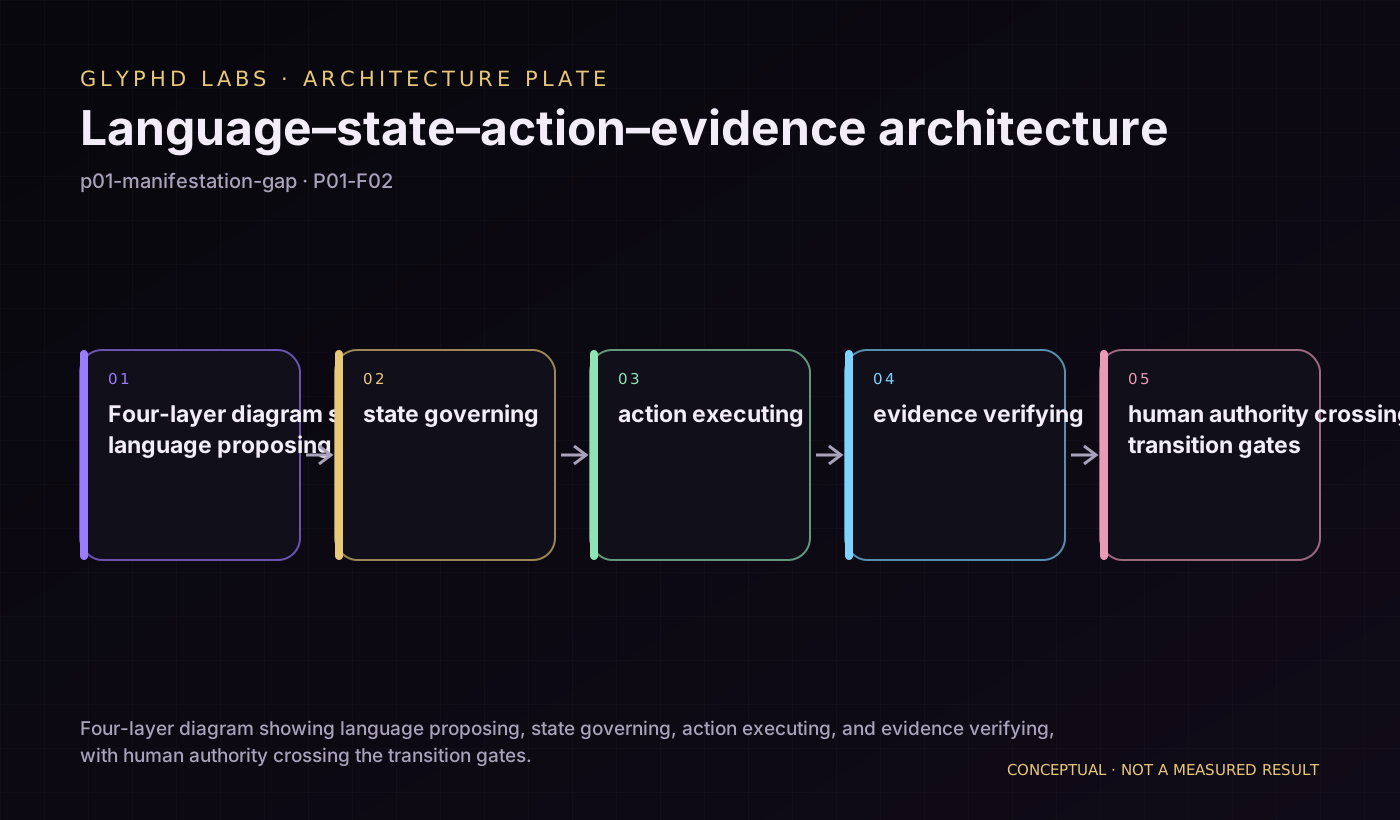
The architecture separates four operations that chat systems often collapse:
LANGUAGE
  proposes, explains, questions, interprets

STATE
  records what is presently recognized

ACTION
  attempts to change state or produce an artifact

EVIDENCE
  establishes what actually happened
The language model participates primarily in interpretation and proposal. A deterministic or otherwise governed runtime owns state transitions. Tools perform bounded actions. Verifiers and receipts connect action to evidence. Human acceptance remains distinct from tool completion.
The minimal loop is:
capture
→ interpret
→ expose the proposed object or change
→ authorize when consequence requires it
→ execute
→ return outputs and evidence
→ verify
→ accept, revise, reject, or leave unresolved
→ update the durable object
→ render the new state
The important distinction is not “AI versus deterministic software.” It is generated assertion versus governed manifestation. A model may generate code, but a repository, compiler, and test runner determine whether the code exists and behaves. A model may suggest a decision, but the accepted Plan records whether the human adopted it. A model may summarize evidence, but source spans and validation determine whether the summary is supported.
4. Manifestation is broader than artifact generation
A naive reading of this thesis would reduce it to “the AI should always make a file.” That is insufficient.
An artifact is one kind of manifestation, but many consequential assistant interactions manifest something else:
- a changed state: an appointment was scheduled;
- a governed commitment: a budget ceiling was approved;
- a simulation: a policy was tested in a branch without changing production;
- a verified understanding: a learner demonstrated mastery;
- a relationship boundary: a visitor request was admitted to one room for one hour;
- a navigable memory: a decision acquired a stable address and provenance;
- a structured uncertainty: two sources conflict and no fact has been promoted;
- a work frontier: dependencies, blockers, and the smallest valid next action are visible;
- an operational surface: a large body of truth is compiled into a task-specific interface;
- a receipt: an exact consequential transition can be replayed and audited.
The key requirement is that the system cannot satisfy a request merely by producing the linguistic shape associated with satisfaction. It must either manifest an appropriate object or explicitly state that the interaction remains exploratory.
5. A state model for manifestation
A general object can move through the following lifecycle:
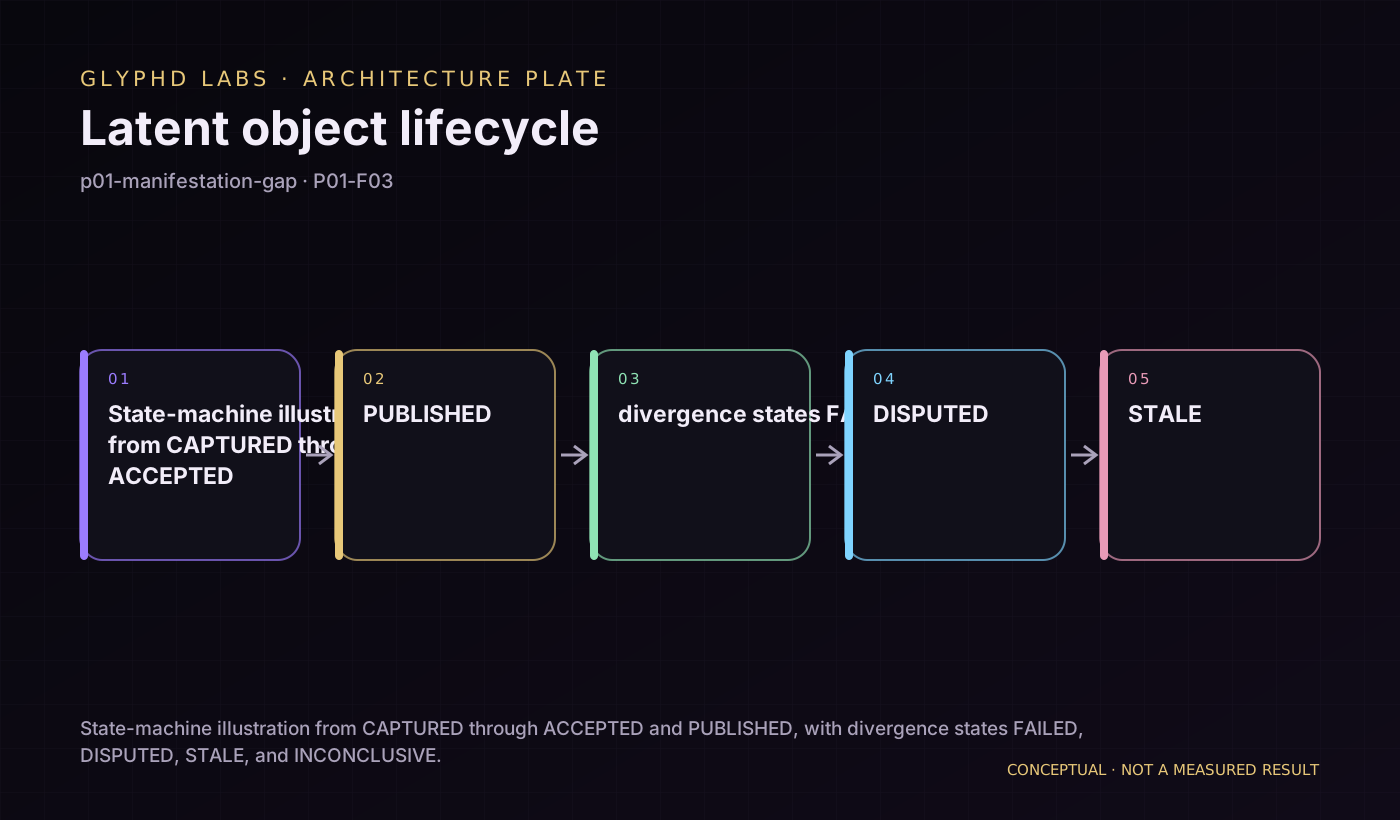
CAPTURED
→ INTERPRETED
→ PROPOSED
→ AUTHORIZED
→ EXECUTING
→ RETURNED
→ VERIFIED
→ ACCEPTED
→ PUBLISHED
Not every object uses every state. Valid divergence states include:
REJECTED
REVISED
BLOCKED
FAILED
DISPUTED
STALE
EXPIRED
ROLLED_BACK
INCONCLUSIVE
AWAITING_EVIDENCE
This state model prevents several common substitutions:
- proposed is not authorized;
- executed is not verified;
- returned is not accepted;
- deployed is not production-sealed;
- described is not performed;
- confidently stated is not true.
The interface should make these distinctions visible. A user should not have to infer them from tone.
6. The manifestation contract
For each consequential interaction, the system should be able to expose a compact Manifestation Contract:
objective
object_id
current_state
desired_state
source_inputs
active_constraints
authority_required
planned_operations
evidence_required
completion_condition
failure_behavior
rollback_route
current_unknowns
The contract need not appear as a bureaucratic form. It can be rendered as a progress surface, a plan, a card, a timeline, a diff, or a simulation. Its purpose is to ensure that language remains attached to a stateful object.
For a software task:
object: repository change
current_state: main@abc123
desired_state: accessible paper routes
constraints: no private material; static-first
authority: write branch, no production cutover
evidence: build, tests, route scan, screenshots
completion: merged verified commit
For a factual research task:
object: claim set
current_state: 11 candidate claims
desired_state: source-backed synthesis
constraints: primary sources; current as of date
evidence: citation per claim; conflict register
completion: every public claim sourced or marked inference
For a creative plan:
object: production packet
current_state: song + references
desired_state: approved shot plan
constraints: identity locks, budget, duration
evidence: asset map, timing, continuity review
completion: director approval before render
7. Progress becomes a projection of state
Once the latent object exists, progress does not need to be hallucinated or represented by arbitrary percentages. It can be derived.
Examples:
- number of claims with evidence versus unresolved claims;
- number of acceptance criteria with receipts;
- dependency frontier remaining before a build;
- difference between accepted result and working candidate;
- model call, cost, and artifact lineage;
- completed experiment cells versus invalid or blocked cells;
- source freshness and citation coverage;
- object state transitions over time.
This produces a different relationship between human and AI. The system does not merely reassure the user that it is “working.” It exposes the work.
The visual form can be rich and spatial. A research object may appear as a constellation of papers, claims, demos, and benchmarks. A project may appear as Chat, Plan, and Make lenses. A persistent memory may appear as a board or atlas. But the visual layer must remain a projection of events and objects. Nothing should move merely to imply intelligence.
8. Relation to Glyphd systems
The manifestation thesis is not one isolated product feature. It is the common rationale behind several Glyphd programs:
- LCSM / Backboard manifests current truth, versions, provenance, and change of mind.
- FOVEA Address Fabric manifests durable information as stable place and bounded attention.
- SurfaceMind manifests verified knowledge as an operational surface.
- GlyphCAS manifests distinct identities and reusable representations without erasing exact proof.
- Actor–Agent Runtime manifests persistent identity separately from temporary computation.
- Glyph Desk manifests thought as Chat, intent as Plan, and authorized realization as Make.
- WorkPage OS manifests an answer as a task-specific interface.
- SchemaStack Signal Gate manifests hidden control as a compact answer contract rather than leaked policy text.
- MCE-1 manifests institutional causality, rights, authority, and appeal inside a synthetic economy.
- Glyphd Labs itself manifests months of distributed research as a citable, testable public corpus rather than another private pile of conversation.
These systems differ in domain, but they share one rule:
The model may contribute language and judgment; the surrounding system must preserve the object that makes the contribution consequential.
9. What this changes about a general assistant
A manifestation-native assistant would classify each interaction by the kind of object it should maintain.
Exploratory conversation
The object may be a question map. The system preserves candidate ideas, disagreements, and unresolved questions without treating them as accepted truth.
Advice
The object may be a decision surface: goals, constraints, options, tradeoffs, assumptions, and the user's eventual choice.
Research
The object is a claim-and-evidence graph with source freshness, conflicts, inference labels, and reproducible queries.
Planning
The object is an executable Plan with dependencies, authority, budgets, acceptance criteria, and failure behavior.
Making
The object is an artifact graph with accepted and working versions, tasks, tool runs, evidence, and receipts.
Coordination
The object is a bounded relationship among actors, roles, commitments, returns, and exit conditions.
Memory
The object is canonical state plus lineage, not a prose recollection synthesized anew each time.
The assistant remains conversational. The difference is that conversation becomes a control and interpretation surface over durable objects.
10. Evaluation
The manifestation thesis is testable. A system claiming to implement it should be evaluated on:
- State reconstruction: can the project or task be reopened after the chat context is removed?
- Authority separation: can a model suggestion be distinguished from a user decision?
- Progress fidelity: does visible progress correspond to actual object transitions?
- Evidence coverage: can completion claims resolve to evidence?
- Non-destructive work: can a new candidate exist without replacing the accepted result?
- Cross-provider continuity: can another model resume from the object without receiving the entire transcript?
- Failure honesty: can the system remain failed or inconclusive without producing completion language?
- Human comprehension: can a user explain what is true, what is proposed, what ran, and what remains?
- Operational yield: does the system produce more accepted outcomes per unit of human reconstruction effort than ordinary chat?
- Object portability: can the user export the object, artifacts, and receipts?
A decisive comparison is ordinary long-form chat versus a manifestation-native surface on the same task. The evaluation should measure time to resume, error in recalling accepted constraints, number of duplicated decisions, time to verify completion, and final accepted output.
11. Failure modes
The architecture can fail in several ways.
Object theater
The interface displays cards, progress bars, and graphs that are not derived from real state. This is merely animated language.
Bureaucratic overload
Every casual interaction becomes a workflow. The correct design must allow conversation to remain lightweight until consequence or persistence justifies structure.
False precision
A system produces exact percentages or state labels from weak inference. Unknown and disputed state must remain visible.
Canon inflation
Every model statement becomes durable truth. Canon must require an authority and evidence path appropriate to the stakes.
Artifact fixation
The system creates files for everything while failing to maintain relationships, decisions, and state.
Hidden mutation
An agent updates the latent object without exposing the proposed delta or authority basis.
Provider capture
The durable object exists only inside one vendor's transcript, memory feature, or proprietary format.
Completion collapse
The system treats tool completion, verification, acceptance, and publication as the same event.
12. Limitations
This paper proposes a general architecture, not a universal formalism for every human activity. Some valuable conversations should remain ephemeral. Some goals are intrinsically ambiguous and resist crisp completion criteria. Human beings also reinterpret their own goals, sometimes productively. A manifestation system must preserve change of mind without freezing the user inside an obsolete plan.
The architecture adds state-management cost. It requires schemas, persistence, versioning, authority, and careful interface design. A poor implementation can feel rigid or managerial. The answer is not to abandon structure but to apply it proportionally: low-stakes conversation may manifest only a lightweight question map, while consequential work receives a complete contract.
The thesis also does not eliminate language-model error. It contains and exposes error by preventing generated language from silently becoming authoritative state.
13. Conclusion
The central discrepancy of present AI systems is simple:
Generating language is not the same thing as doing what the language says.
The strategic response is equally simple in theory, though demanding in implementation:
Intelligence should manifest alongside its language.
The manifestation may be an artifact, but it may also be state, a surface, a simulation, a relationship, a receipt, or a preserved unknown. The critical property is that the human and machine share a durable object whose change can be observed and whose truth is not determined by verbal confidence.
A language model can remain the architect, interpreter, critic, and collaborator. The manifestation layer is the rendered world in which that language acquires consequence.
Architecture illustration briefs
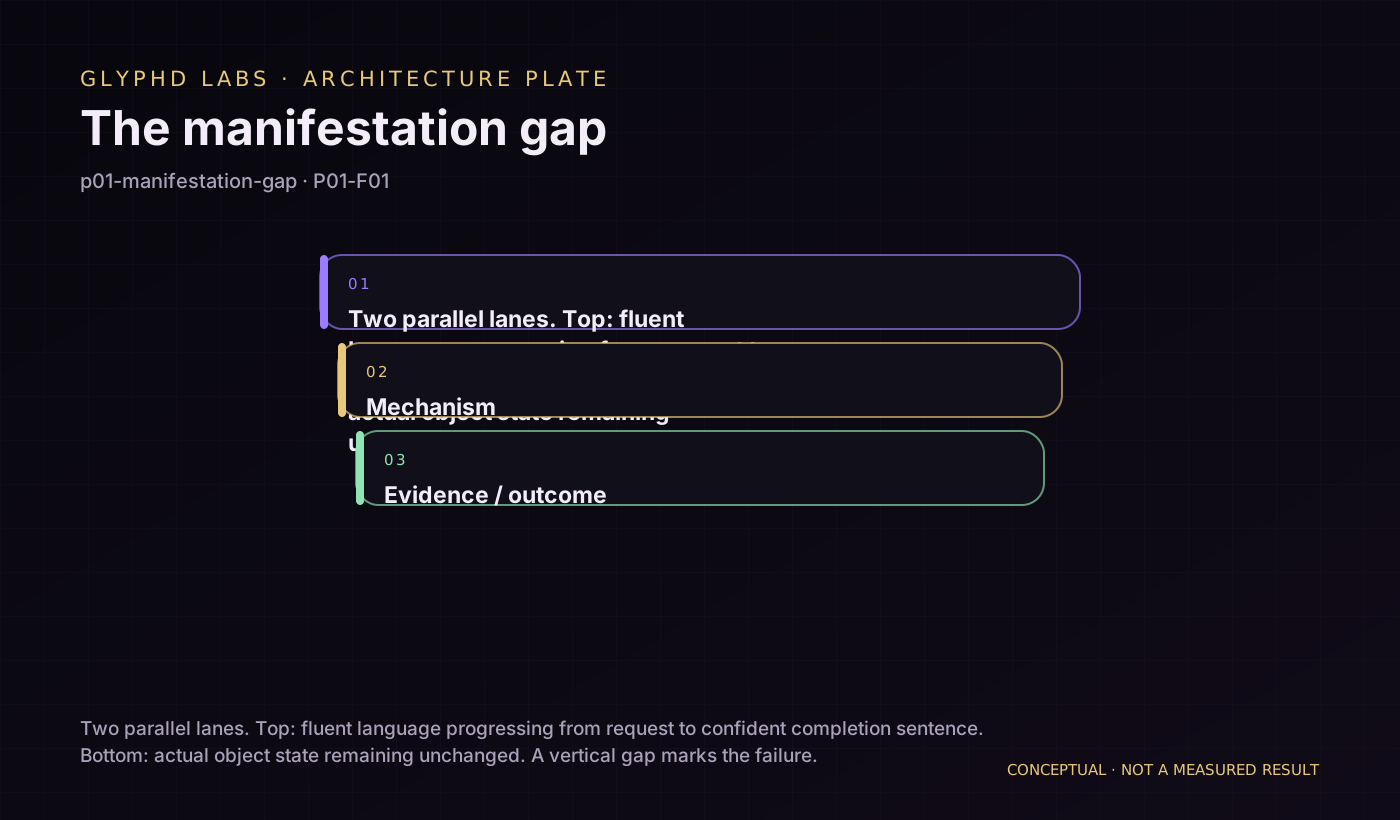
- P01-F01 — The manifestation gap: Two parallel lanes. Top: fluent language progressing from request to confident completion sentence. Bottom: actual object state remaining unchanged. A vertical gap marks the failure.
- P01-F02 — Language–state–action–evidence architecture: Four-layer diagram showing language proposing, state governing, action executing, and evidence verifying, with human authority crossing the transition gates.
- P01-F03 — Latent object lifecycle: State-machine illustration from CAPTURED through ACCEPTED and PUBLISHED, with divergence states FAILED, DISPUTED, STALE, and INCONCLUSIVE.
Source register
- P01-S01 — Founder note: Generating language is not the same thing as doing what the language says (2026-07-27).
project conversation / AI Manifestation and Progress - P01-S02 — GLYPH DESK — CHAT · PLAN · MAKE (2026-07-12).
GLYPH-DESK-MASTER-SPEC.v1.md - P01-S03 — Workpage OS Spec Pack v1.1 (2026-06-18).
Workpage_OS_Spec_Pack_v1_1.md - P01-S04 — LCSM Workbench E2E Specification (2026-07-04).
LCSM-WORKBENCH-E2E-SPEC.v0.md - P01-S05 — Glyphd V1 Master-Spec Locks and Experiment Plan (2026-07-18).
GLYPHD-V1-MASTER-SPEC-LOCKS-AND-EXPERIMENT-PLAN-v0.1.md
Public-disclosure and IP boundary
This paper publishes the high-level system thesis and public-safe state model. It does not disclose private implementation heuristics, unpublished patent claim language, private source corpora, or production authorization policies. Publication does not grant implementation rights under the Glyphd Proprietary Research and Technology License.
P01-C01VERIFIED MECHANISMGenerated language can imitate the report of completion without any necessary external state change.
- No controlled user study is reported in this edition.
P01-C02SPECIFIEDA durable latent object can separate proposal, authorization, execution, verification, acceptance, and publication.
- Benefits require comparative experiments.
P01-C03HYPOTHESISProgress should be rendered from object state and evidence rather than generated as conversational reassurance.
- Interface cost and user preference remain to be measured.
These provenance records identify sources used by the publication. An internal path is not a public download unless a link is explicitly provided.
P01-S01P01-S02P01-S03P01-S04P01-S05v0.1.0First synthesized public-safe institute edition compiled from the Glyphd project corpus.
This paper publishes the high-level system thesis and public-safe state model. It does not disclose private implementation heuristics, unpublished patent claim language, private source corpora, or production authorization policies. Publication does not grant implementation rights under the Glyphd Proprietary Research and Technology License.