
Virtual Fiber
Resolution-scaled hybrid optical multipath transport for bonding ordinary data links with display-to-camera subflows
Abstract
Modern personal devices frequently possess several simultaneous communication resources: Wi-Fi, cellular service, Ethernet through a nearby computer, USB, Bluetooth, displays, cameras, and increasingly dedicated neural or graphics processors. Conventional networking treats the display and camera as user-interface peripherals rather than as a network path. Recent browser-based screen-to-camera demonstrations show that ordinary screens and phone cameras can already move fountain-coded payloads through visible light at useful proof-of-concept rates without device pairing or a direct network connection.
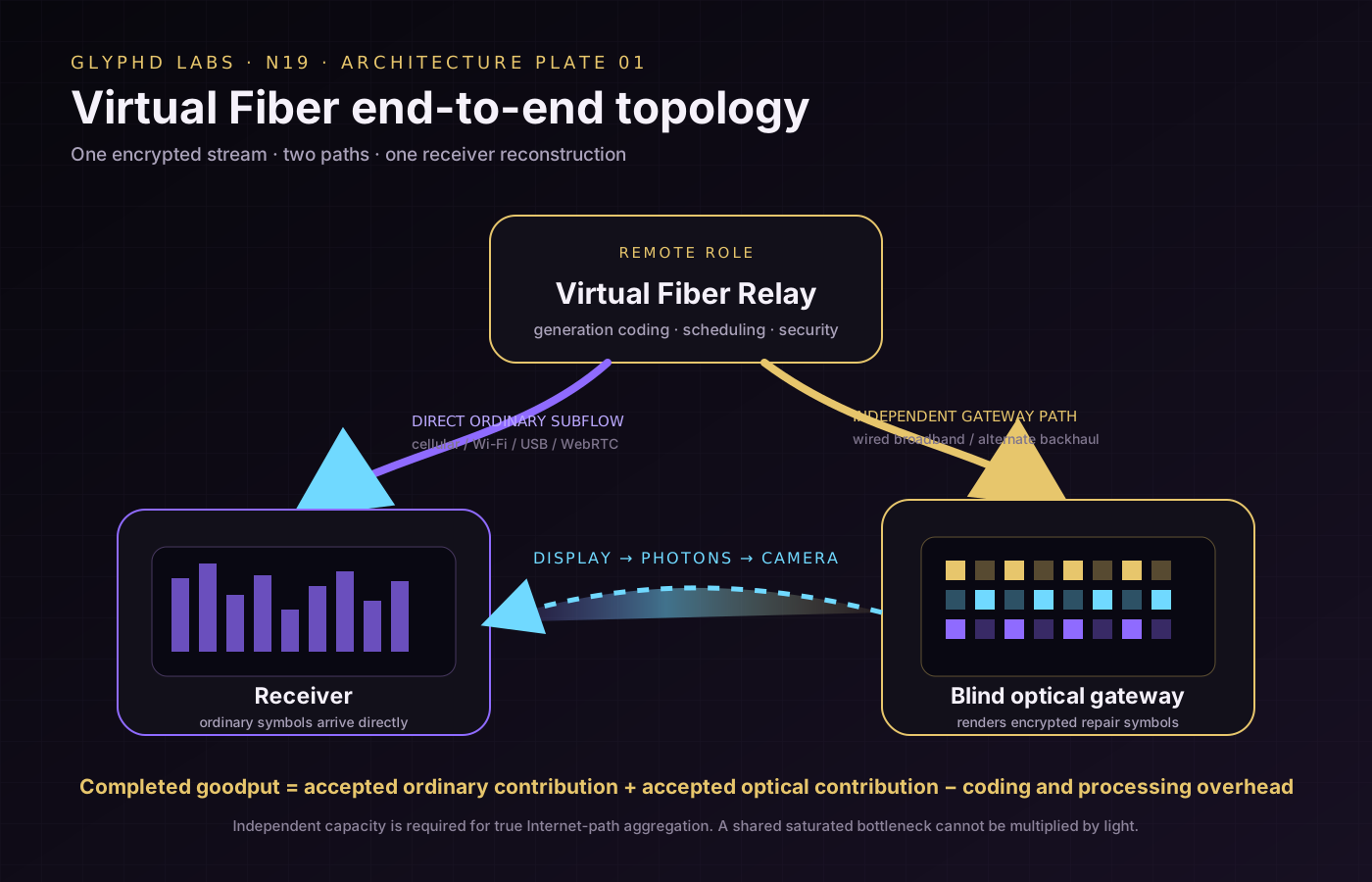
Virtual Fiber specifies a hybrid transport that bonds an ordinary bidirectional data link with one or more display-to-camera optical subflows and exposes them as one logical connection. The ordinary path carries low-latency control, acknowledgements, encryption setup, requests, congestion feedback, and baseline traffic. The optical path carries additional coded symbols from the same source stream. A receiver reconstructs each source generation from any sufficient combination of ordinary and optical symbols, so missed optical frames reduce contributed throughput without stalling the connection.
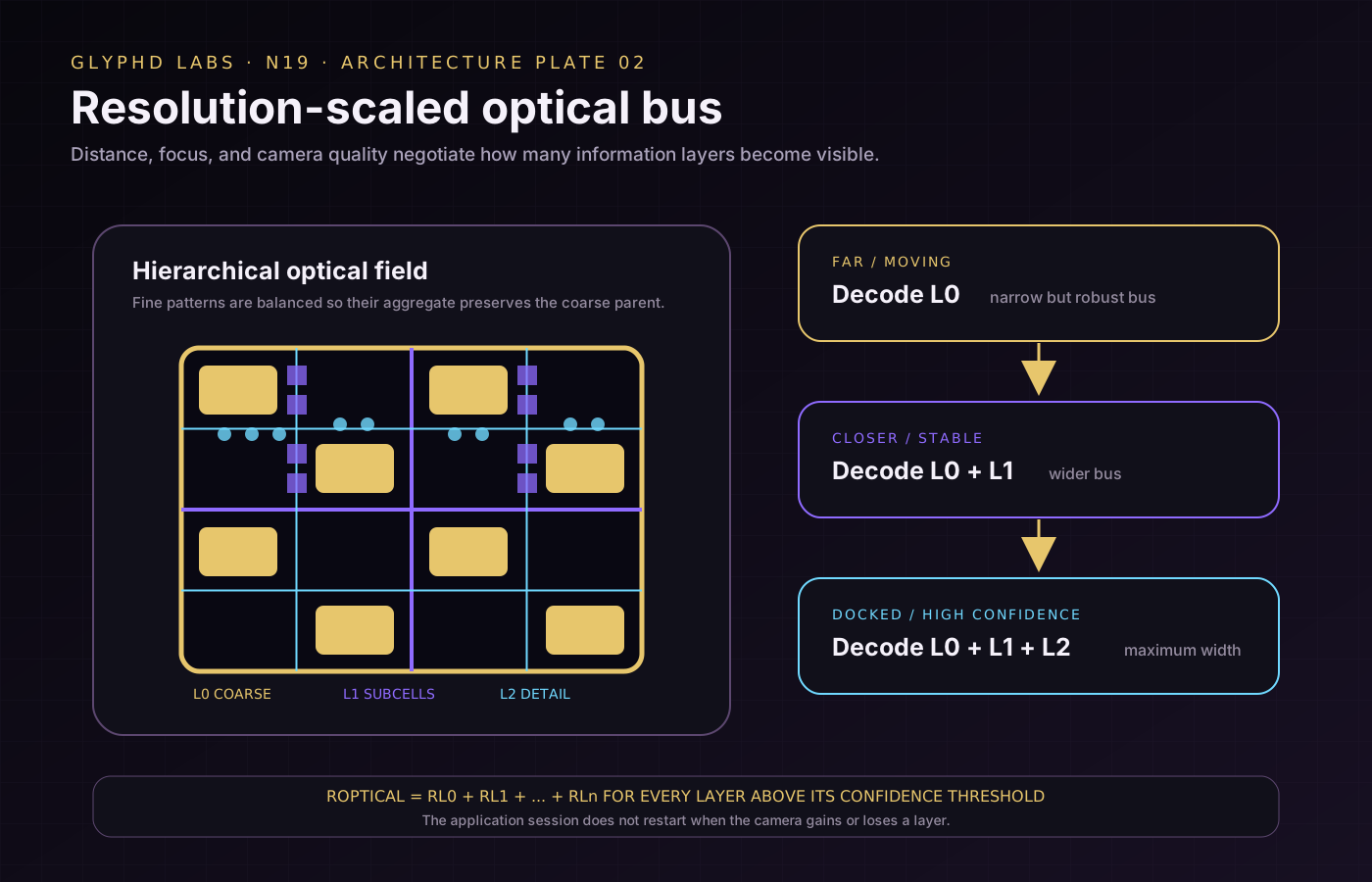
The optical path is resolution-scaled. Bus speed is not a fixed barcode setting; it is the number of reliable information symbols the receiving camera can resolve per frame, multiplied by frame rate, coding efficiency, and successful-frame rate. A hierarchical optical field can expose coarse, medium, and fine symbol layers simultaneously. A distant camera decodes only the coarse layer. A closer or better camera resolves additional layers and therefore widens the effective bus without renegotiating the application connection.
Virtual Fiber does not claim that a commodity phone camera presently equals physical fiber, that optical transmission creates Internet capacity from nothing, or that combining two paths always produces their arithmetic sum. The architecture produces genuine access-network aggregation only when the ordinary and optical routes contribute distinct usable capacity—for example, a phone receives part of a stream through cellular service while a nearby computer receives additional encrypted symbols through wired broadband and emits them optically to the phone. If both routes share the same saturated bottleneck, optics may still provide local delivery, resilience, one-to-many distribution, or interface benefits, but not additional upstream Internet capacity.
The present contribution is a bounded protocol architecture: endpoint roles, cross-path coding, multiresolution optical layers, security boundaries, scheduling rules, state transitions, acceptance criteria, and falsification conditions. No bonded implementation or measured Virtual Fiber result is claimed.
1. Canonical thesis
Virtual Fiber is a secure multipath transport that compounds an ordinary data connection with one or more resolution-scaled display-to-camera optical subflows, using cross-path erasure coding so that every successfully observed optical symbol contributes to one logical connection without becoming a reliability bottleneck.
This sentence is the canonical definition for version 1.0.
Later work may replace QR, fountain-code families, modulation schemes, camera pipelines, transport protocols, displays, relays, or scheduling algorithms. It may add infrared emitters, event cameras, microLED arrays, multiple receivers, or direct optical return channels. Those changes are compatible only if the system still preserves four invariants:
- One logical connection. Applications do not manage separate ordinary and optical downloads.
- Additive successful work. A valid optical symbol advances reconstruction of the same logical byte stream.
- Failure independence. Loss of the optical view degrades capacity but does not freeze the ordinary path.
- Resolution-scaled width. The optical contribution expands and contracts with the reliably resolved information field.
Future iteration must not silently turn Virtual Fiber into an ordinary animated-code file transfer, a replacement name for LiFi, a claim of impossible compression, or an assertion that every screen-camera link is faster than radio.
2. Why this is not merely a second download
A naive implementation could split a file into two fixed sets of packets: even packets over Wi-Fi and odd packets over the screen. That design fails under the exact conditions that make optical camera communication interesting.
Camera frames are missed because of blur, rolling-shutter interactions, autofocus, refresh straddling, exposure, occlusion, perspective, processing backpressure, and thermal throttling. A fixed missing optical packet can block reassembly even while the ordinary path remains healthy. Retransmitting it over the ordinary path introduces delay and scheduler complexity. Repeating optical frames wastes capacity and creates long recovery cycles.
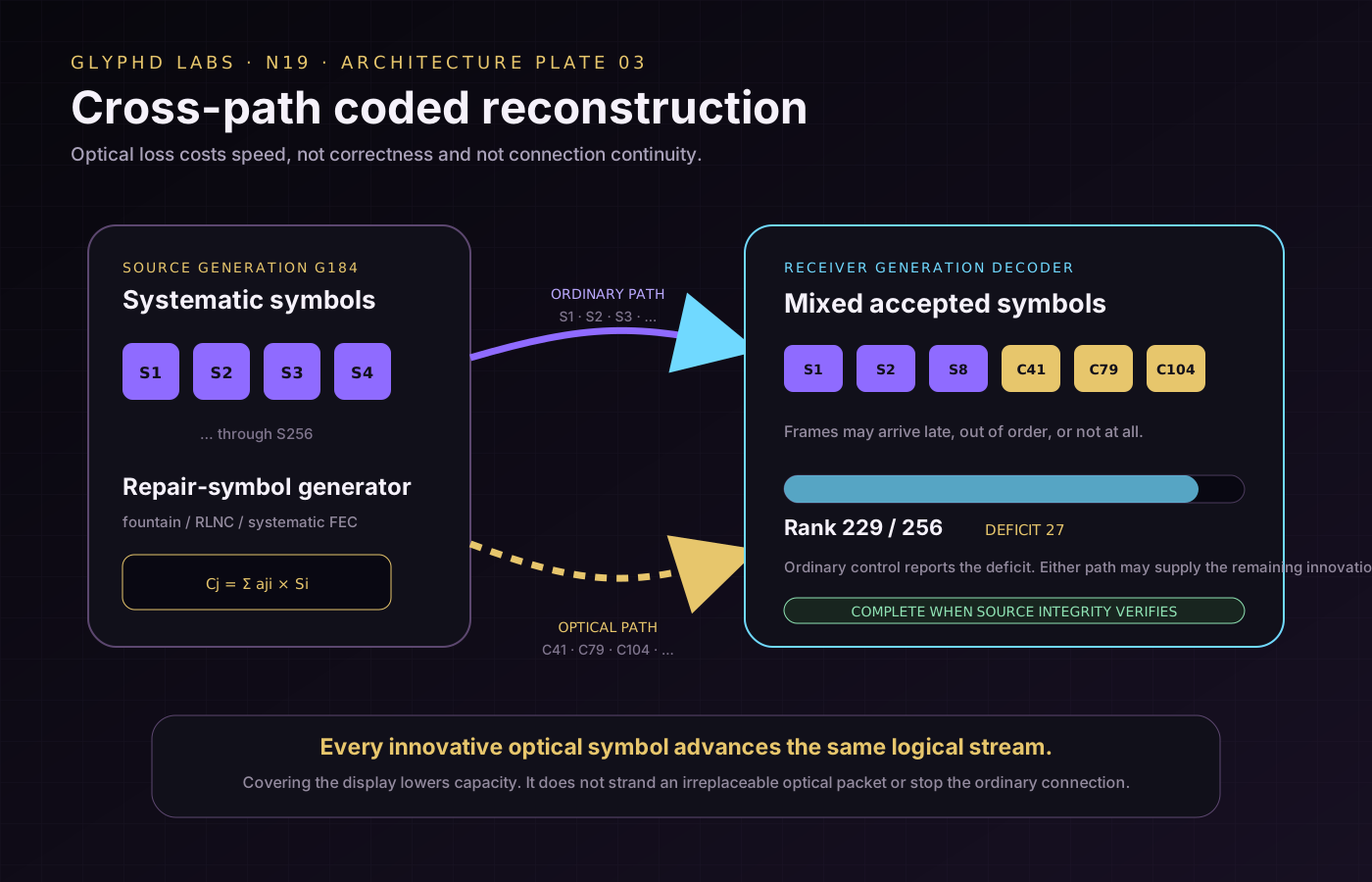
Virtual Fiber therefore does not assign irreplaceable byte ranges to the optical path. It divides the source stream into bounded generations and emits enough independent symbols for the receiver to reconstruct each generation from whichever paths succeed.
Source generation G184

S1  S2  S3  S4  ...  S256
│   │   │   │          │
├──────── ordinary systematic symbols ────────►
└──────── optical repair symbols ─────────────►

Receiver completes G184 when decoding rank reaches the generation target.
The ordinary path normally sends systematic source symbols because they can be consumed immediately and require no decoding when received intact. The optical path normally sends repair symbols derived from the same generation. The receiver reports generation rank and deficit through the ordinary control channel. The sender or relay stops producing repair symbols for a completed generation and advances.
This is cross-path coding rather than packet striping.
A RaptorQ-like fountain code, random linear network code, or another systematic erasure code may implement the mechanism. The architecture does not require one code family at the specification level. It requires these properties:
- repair symbols can be generated without waiting for a particular loss report;
- any sufficiently informative set can reconstruct the generation;
- symbol identity and coding coefficients are deterministic or compactly described;
- duplicate or dependent symbols can be detected;
- decoding progress can be expressed as rank or equivalent deficit;
- source integrity is verified after reconstruction.
3. System roles
Virtual Fiber has four logical roles. One physical device may perform several roles.
3.1 Virtual Fiber relay
The relay is the Internet-facing endpoint that presents one logical encrypted transport to the receiver. It:
- accepts application traffic or a tunneled byte stream;
- divides data into generations;
- produces systematic and repair symbols;
- schedules symbols across available subflows;
- receives rank, loss, delay, and optical-quality reports;
- cancels obsolete work;
- and enforces connection-level security and congestion policy.
The relay may be a cloud service, local server, router, operating-system daemon, browser peer, or application-specific gateway.
3.2 Optical gateway and emitter
The optical gateway receives symbols intended for an optical subflow and renders them through a screen or dedicated emitter. In a privacy-preserving deployment it receives ciphertext and does not need access to the application plaintext.
It is responsible for:
- display calibration;
- frame timing;
- geometric fiducials;
- optical profile selection;
- multiresolution symbol rendering;
- screen brightness and occupied-area policy;
- and status reporting to the relay.
A laptop connected to wired broadband can be both a network gateway and a display emitter. A television, tablet, projector, microLED panel, or purpose-built optical tile can perform the same logical role.
3.3 Receiver
The receiver observes the optical field through a camera while also maintaining the ordinary connection. It:
- captures and rectifies display frames;
- estimates optical channel quality;
- decodes all resolvable hierarchy layers;
- authenticates and deduplicates symbols;
- combines ordinary and optical symbols;
- reconstructs generations;
- exposes the ordered logical stream;
- and reports rank and channel telemetry.
The first receiver is expected to be a phone. The architecture also supports tablets, headsets, robots, cameras, embedded systems, or dedicated optical receivers.
3.4 Ordinary subflow
The ordinary subflow may be Wi-Fi, cellular, Ethernet, USB, Bluetooth, WebRTC, QUIC, TCP, or another bidirectional transport. It is not treated as an inferior fallback. It is the stable control spine that makes the optical path practical.
It carries:
- session establishment;
- cryptographic key agreement;
- requests and interactive input;
- acknowledgements and rank reports;
- congestion and path telemetry;
- urgent or latency-sensitive data;
- baseline stream symbols;
- and any data that must continue when the camera cannot see the screen.
4. When throughput is genuinely additive
Virtual Fiber must distinguish link aggregation from visual relaying.
Consider a phone with a 20 Mbps cellular connection and a nearby computer with a 200 Mbps wired connection. A remote relay sends one portion of a download directly to the phone and sends additional coded symbols to the computer. The computer renders those symbols. The phone camera receives them. If the optical path contributes 5 Mbps of verified payload after overhead, the phone may approach 25 Mbps of aggregate goodput, subject to processing, congestion, relay scheduling, and shared upstream constraints.
Remote relay
   ├── direct path: cellular ─────────────► phone
   └── gateway path: wired broadband ────► computer display
                                             │ photons
                                             ▼
                                           phone camera
The optical last hop bypasses the phone's direct radio path by borrowing the computer's separate backhaul.
By contrast, if the phone and computer both receive through the same saturated 20 Mbps household connection, the system cannot obtain 25 Mbps from that 20 Mbps bottleneck merely by adding light inside the room. It can still redistribute which endpoint receives which bytes, exploit idle local capacity, provide a networkless last hop, broadcast common data, or preserve service when one local interface is unavailable. It cannot violate the capacity of the shared bottleneck.
This boundary is mandatory in all public descriptions:
Virtual Fiber compounds independently available path capacity. It does not create upstream bandwidth from a shared saturated source.
5. Resolution is bus width
The optical contribution is governed by reliable distinguishability, not nominal pixels alone.
A useful first-order expression is:
Roptical = Cframe × Fcapture × Ecoding × Psuccess
where:
Cframeis the information capacity of all reliably resolved optical cells in one captured frame;Fcaptureis effective decoded frame rate, not requested camera frame rate;Ecodingis payload efficiency after framing, pilots, authentication, and error correction;Psuccessis the proportion of frames or symbols accepted as valid.
Cframe changes with:
- display resolution and physical size;
- camera sampling resolution;
- distance and angle;
- focus and motion blur;
- display refresh and camera exposure;
- rolling-shutter behavior;
- brightness and ambient light;
- color separation;
- occupied screen area;
- optical-cell design;
- and decoder confidence thresholds.
The bus therefore has variable width.
5.1 Simultaneous multiresolution layers
A basic system could stop transmission, enlarge its symbols, and restart at a slower profile whenever conditions worsen. Virtual Fiber instead specifies a hierarchical optical field in which several scales can coexist.
Each coarse cell contains balanced finer subcells. The aggregate appearance of the finer pattern preserves the parent symbol. A low-resolution observation recovers the parent. A higher-resolution observation also recovers the children.
L0: coarse symbols visible at distance
 └─ L1: four balanced subcells per L0 cell
     └─ L2: finer subcells resolved at closer range
         └─ L3: optional color or temporal detail
The optical rate becomes:
Roptical = RL0 + RL1 + RL2 + ... + RLn
for every layer whose confidence remains above its decoding threshold.
A receiver moving away may lose L2 while retaining L0 and L1. A docked receiver may decode all layers. The application connection remains unchanged. The optical scheduler simply receives a narrower or wider contribution.
This architecture must be experimentally validated. The central hypothesis is that independently decodable balanced hierarchy layers can preserve robust coarse decoding while adding useful fine-layer capacity under favorable geometry.
5.2 Optical profiles
An implementation should expose named profiles without confusing them with guaranteed rates:
- Beacon: discovery, session binding, clock, and minimal status.
- Ambient: small persistent panel with low visual disruption.
- Overlay: a visible regional panel while the display remains usable.
- Burst: most or all of the screen becomes a transmitter.
- Docked: fixed receiver geometry, locked exposure, maximum stable density.
- Array: several screens or screen regions operate as independent optical subflows.
The negotiated profile controls occupied area, cell size, modulation, color use, frame cadence, hierarchy depth, and redundancy.
6. Connection establishment
A secure hybrid session should use the ordinary path to authenticate the visible emitter rather than assuming line of sight is identity.
6.1 Establishment sequence
- The receiver establishes an authenticated encrypted session with the relay over the ordinary path.
- An optical gateway joins the same relay session through an authorized gateway credential or user-approved invitation.
- The relay assigns an optical path identifier and sends the gateway encrypted path material.
- The gateway displays a short-lived visual challenge and calibration field.
- The receiver observes the challenge and returns its value through the authenticated ordinary connection.
- The relay binds the visible emitter, receiver, connection, and path epoch.
- The gateway begins rendering encrypted optical symbols.
- The receiver reports resolved layers and channel statistics.
- The scheduler begins cross-path generation delivery.
A camera recording of a previous session must not create a valid current subflow. The challenge, epoch, nonce domain, and authenticated symbol headers make the optical frames session-specific.
6.2 Blind gateway mode
The gateway may be allowed to render only ciphertext. The relay encrypts application symbols end to end for the receiver. The gateway learns:
- that a Virtual Fiber session exists;
- approximate rate and duration;
- optical profile;
- symbol framing information;
- and whatever network metadata is unavoidable.
It need not learn the files, websites, prompts, model outputs, or application data being transmitted.
This is important when a public display, employer-managed computer, shared television, or temporary kiosk provides the optical path.
7. Optical symbol envelope
Each accepted symbol needs enough context to be independently useful and safely discardable.
A conceptual envelope contains:
protocol_version
connection_id
optical_path_id
path_epoch
generation_id
symbol_id
coding_scheme
coding_seed_or_coefficients
hierarchy_layer
profile_id
payload_length
ciphertext
AEAD_tag
The optical frame also contains non-payload regions for:
- geometric fiducials;
- perspective and orientation recovery;
- frame and epoch synchronization;
- color and luminance pilots;
- profile identification;
- and frame-level error detection.
The exact wire layout remains implementation work. The first codec may use multiple QR codes or a custom matrix because existing decoders simplify the proof. The canonical architecture does not make QR a permanent dependency.
8. Scheduling and congestion control
The scheduler has two distinct jobs: decide which source information is still needed, and decide which path should carry useful symbols next.
8.1 Generation scheduler
For each active generation the relay tracks:
- source symbol count;
- symbols sent by each path;
- receiver rank or recovered count;
- estimated in-flight innovation;
- completion deadline;
- and application priority.
The optical path should avoid sending repair symbols whose expected usefulness is lower than another generation's deficit. The ordinary path may send final rescue symbols when an interactive deadline approaches.
8.2 Traffic classes
The architecture recommends:
Ordinary-preferred
- input events;
- acknowledgements;
- conversational prompts;
- audio timing;
- cryptographic control;
- and small latency-sensitive messages.
Hybrid-coded
- downloads;
- software packages;
- documents;
- AI token streams with structured metadata;
- media segments;
- model assets;
- and bulk application state.
Optical-preferred
- one-to-many common assets;
- content already cached at the gateway;
- repeated repair symbols;
- public broadcasts;
- and enhancement layers that may disappear without breaking baseline service.
8.3 Layered media
A clean early product is layered media delivery. The ordinary connection carries audio, controls, and a guaranteed base video layer. Optical symbols carry higher-resolution detail, additional frames, HDR data, or enhancement tiles. Losing the screen view lowers quality instead of stopping playback.
This demonstrates variable optical bus width in a way users can see immediately.
9. Array mode and the virtual bundle
Several visible emitters can act as separate optical subflows. Each emitter receives a distinct path identifier and sends innovative symbols from the same active generations.
Display A ──► optical path 1 ─┐
Display B ──► optical path 2 ─┼─► receiver generation decoder
Display C ──► optical path 3 ─┤
Ordinary network subflow ─────┘
Adding a display should increase net goodput only when the camera can independently resolve its field and the receiver has decoding capacity available. More illuminated pixels do not guarantee more accepted data. The acceptance metric is verified contribution to completed source generations.
Array mode is the transport bridge to the first locked optical-processing use case: an elastic personal compute fabric. Nearby devices can form a visible compute cluster while the same optical fields provide discovery, synchronization, task assignment, status, compact results, and optional data movement.
10. Relationship to optical intelligence casting
The second locked use case is optical intelligence casting: a connected or computationally powerful machine streams frontier-model output to a disconnected phone through the display-camera path.
LLM text output is extremely small relative to demonstrated visible optical payload rates. Virtual Fiber generalizes that one-way idea by making the optical output an authenticated subflow of a live logical connection. The ordinary path can carry prompts and control when available. In a fully disconnected terminal, the phone can display a brief optical return packet to the computer's camera.
The useful proposition is not that the model runs on the phone. It is:
A device can borrow cognition from a system it can see.
Virtual Fiber supplies the transport substrate beneath that experience. It also allows the intelligence stream to include typed structured output, citations, action proposals, and local capability requests instead of plain text alone.
11. Security and abuse boundaries
Line of sight is a propagation condition, not an authorization policy.
Virtual Fiber requires:
- authenticated encryption for optical payloads;
- receiver and gateway authorization;
- short-lived path epochs;
- replay protection;
- per-frame or per-symbol integrity;
- strict decoder memory and CPU limits;
- malformed-symbol rejection;
- duplicate suppression;
- explicit user indication when a camera is receiving data;
- permission boundaries for any structured action delivered to the receiver;
- and rate limits for optical join attempts.
A hostile display could attempt to consume decoder resources, spoof a known field, inject malformed dimensions, exploit barcode libraries, or visually track a receiver. Implementations must treat optical input as untrusted network input.
The receiver must not execute transmitted actions merely because they were validly decoded. Transport authenticity proves which session sent the bytes; it does not grant application authority.
12. MVP sequence
Phase A — Bonded local object transfer
- One computer display and one phone camera.
- One ordinary WebRTC or WebSocket path.
- One optical path derived from the same source generations.
- Live direct-rate, optical-rate, overhead, and net-goodput instrumentation.
- Occluding the display removes optical capacity without interrupting completion.
Phase B — Resolution adaptation
- At least three optical density layers or profiles.
- Automatic camera telemetry.
- Distance and focus changes produce graceful upshift and downshift.
- Net goodput changes are measured from verified decoded payload.
Phase C — Independent Internet paths
- Phone direct path uses cellular or constrained Wi-Fi.
- Optical gateway uses a distinct wired or wireless backhaul.
- A remote relay schedules one encrypted generation stream across both.
- Gateway operates in blind ciphertext-forwarding mode.
Phase D — Virtual network interface
- A TUN or equivalent virtual interface exposes Virtual Fiber below applications.
- Arbitrary downloads and application traffic use the hybrid connection.
- Policy keeps low-latency traffic on the ordinary path.
Phase E — Optical array
- Two or more emitters contribute distinct repair symbols.
- Adding and removing an emitter changes capacity without resetting the connection.
- The receiver reports per-path verified contribution.
13. Acceptance contract
A prototype may claim IMPLEMENTED only when the architecture exists in running code and passes deterministic tests for framing, coding, reconstruction, authentication, fallback, and state transitions.
A result may claim VERIFIED_MECHANISM for additive hybrid transport only when a receipted experiment demonstrates all of the following:
- Positive optical contribution. Net completed payload goodput exceeds the same ordinary path under matched conditions.
- No optical head-of-line blocking. Covering the screen does not freeze the logical stream.
- Cross-path reconstruction. A generation completes from a mixed set of ordinary and optical symbols.
- Graceful loss and return. The optical path can disappear and rejoin without rebuilding the application session.
- Truthful accounting. Reported optical speed counts authenticated payload incorporated into completed generations, not rendered pixels or raw camera input.
- Security checks. Replayed frames, wrong-session frames, tampered symbols, and unauthorized emitters are rejected.
- Resolution response. A controlled change in resolvable layer depth produces a corresponding measured change in optical goodput.
- Bottleneck disclosure. The test identifies whether the two routes share any constrained upstream resource.
Array mode requires an additional gate: adding another independently resolved emitter must increase completed payload goodput after decoding and processing overhead.
14. Falsification criteria
The strongest architecture claims should be reduced or rejected if experiments show that:
- optical decoding consumes more power or compute than the added payload is worth in intended devices;
- ordinary camera pipelines cannot maintain a stable enough contribution outside contrived docking conditions;
- cross-path repair overhead and delay erase the optical gain;
- simultaneous hierarchy layers materially damage coarse-layer robustness;
- the gateway cannot remain meaningfully blind in practical deployments;
- user-visible transmission is too disruptive for any valuable workload;
- imperceptible modes deliver insufficient capacity for their intended role;
- multi-display array decoding fails to scale because camera resolution or processing becomes the dominant bottleneck;
- or existing radio and wired bonding methods deliver the same user value with substantially less complexity.
A failed commodity implementation would not disprove high-speed dedicated display-camera interconnects. It would disprove the relevant commodity-device product claim.
15. Evidence state
The present note is SPECIFIED.
Source-reviewed mechanisms
Public prior work establishes that:
- screens and cameras can form data links;
- animated visual codes can survive frame loss through fountain coding;
- ordinary transports can expose one logical connection over several paths;
- and fountain codes can reconstruct source blocks from nearly any sufficient set of encoding symbols.
The cited Decimen project reports a larger experiment reaching approximately 128 KB/s handheld and 186 KB/s with devices propped, while its public proof uses a deliberately conservative configuration. These are project-reported figures and have not been independently reproduced by Glyphd Labs.
Specified composition
This note specifies:
- a normal bidirectional control path;
- an optical repair-symbol subflow;
- generation-level cross-path reconstruction;
- resolution-scaled hierarchical optical layers;
- blind encrypted gateway operation;
- independent-backhaul aggregation boundaries;
- path state and fallback behavior;
- and a staged acceptance contract.
Unverified hypotheses
The following remain hypotheses:
- net goodput can approach the sum of ordinary and optical contributions after overhead;
- simultaneous multiresolution encoding can provide useful additive layers;
- several displays can form a scalable optical bundle;
- commodity devices can provide sufficient energy efficiency and ergonomic stability for broad use;
- and a hybrid optical path can become a market-significant consumer transport.
16. Publication boundary
This note publicly discloses the Virtual Fiber name, canonical thesis, high-level transport roles, cross-path coding composition, multiresolution bus model, security boundary, state logic, test plan, and intended use-case relationships.
It does not disclose private implementation code, unpublished optimized modulation patterns, commercial deployment plans, patent-ready claim drafting, secret credentials, restricted source material, or measured Glyphd Labs results. It does not claim that Virtual Fiber is patented, standardized, deployed, production-ready, fiber-speed on commodity devices, or superior to existing radio and wired transports.
Source register
- N19-S01 — Hayden Lindley, founder concept record for a variable-resolution hybrid optical bus compounded with an ordinary data link, August 1, 2026. Public-safe synthesis authored in this note.
- N19-S02 — Decimen Optical Transfer, browser-based fountain-coded QR file transfer proof and reported parent-experiment rates: https://github.com/bashalarmistalt/decimen-optical-transfer.
- N19-S03 — A. Ford et al., “TCP Extensions for Multipath Operation with Multiple Addresses,” RFC 8684, March 2020: https://www.rfc-editor.org/rfc/rfc8684.html.
- N19-S04 — M. Luby et al., “RaptorQ Forward Error Correction Scheme for Object Delivery,” RFC 6330, August 2011: https://www.rfc-editor.org/rfc/rfc6330.html.
- N19-S05 — N. Saeed et al., “Optical Camera Communications: Survey, Use Cases, Challenges, and Future Trends,” 2018: https://arxiv.org/abs/1812.01259.
- N19-S06 — V. Tran et al., “DeepLight: Robust & Unobtrusive Real-time Screen-Camera Communication for Real-World Displays,” 2021: https://arxiv.org/abs/2105.05092.
- N19-S07 — J. Kim et al., “Display Field Communication: Enabling Seamless Data Exchange in Screen–Camera Environments,” Photonics 11(11), 2024: https://doi.org/10.3390/photonics11111000.
- N19-S08 — X Display Company, “XDC Demonstrates Breakthrough High-Speed Display for Free-Space Optical Wireless Communication,” June 19, 2025. Company-reported roadmap and demonstration context, not independent Glyphd evidence: https://www.xdisplay.com/pressrelease/xdc-demonstrates-breakthrough-high-speed-display-for-free-space-optical-wireless-communication/.
- N19-S09 — “The Future Is Foveated,” Glyphd Labs P03, for deterministic address and foveated retrieval context.
Revision rule
Version 1.0.0 is the locked concept baseline. Revisions must append a dated change record in Git history and preserve the canonical thesis, evidence boundaries, and rejected claims. New codec experiments belong in demonstrations, benchmarks, or versioned implementation notes. They must not rewrite this origin architecture merely because a later implementation chooses different machinery.